 EN
 SK


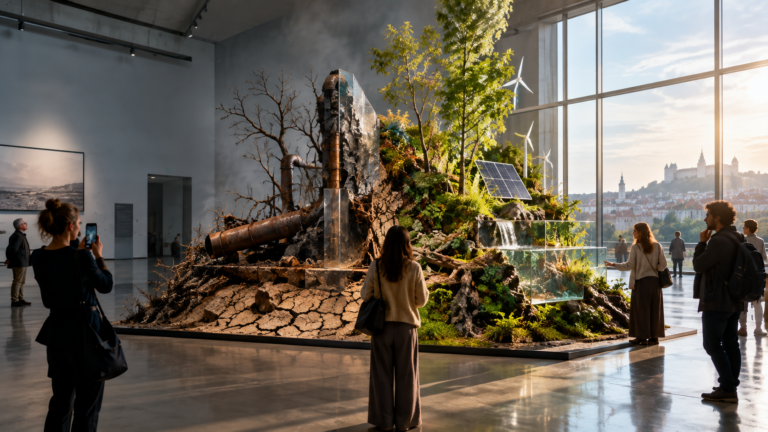
Amid the growing climate crisis, a three-year-old shows research University College Cork, how creative approaches empower communities, change behaviour and support just transition. Traditional scientific warnings and policy strategies on climate change changes often encounter communication barriers, passivity or a sense of helplessness on the part of the public. The final evaluation report by researchers from University College Cork (UCC) – Marguerite Nyhan, Michelle Burke, Maria Ruiz Carreras and Jennifer Ahern – provides compelling evidence that the arts and culture sector can act as an extremely effective accelerator for community engagement and lasting behavior change. The report evaluates the national program Creative Climate Action Fund II: Agents of Change, which was funded by the organization Creative Ireland in collaboration with the Irish Ministries of Culture, Environment and the Office of the Prime Minister. The programme supported a total of 42 creative and artistic projects across Ireland, which aimed not only to raise awareness of the climate crisis, but above all to guide individuals and communities towards practical and sustainable action.
Initiative structure and scope: Ignite and Spark
The entire initiative was divided into two main streams that addressed different levels of society:
- Strand 1: Ignite included 19 major interdisciplinary projects with a national reach and extensive public involvement. These included three specific projects funded under the initiative Shared Island, which brought together people across the island of Ireland to address common environmental challenges.
- Strand 2: Spark funded 23 annual projects aimed at testing innovative public engagement ideas at the local and community level.
To gain in-depth insight, the UCC research team conducted a detailed case study („deep dive“) of six representative projects. This included, for example, the project Creative Boardroom: Collaborate4Climate, which connected the creative sector with business leaders, Field Exchange focused on sustainable agriculture and agroforestry, or a project The Eco-Makers Workshop focused on inclusive education and circular economy.
Robust methodology and analytical model COM-B
The evaluation was conducted over a three-year period using a combination of quantitative and qualitative research methods. The researchers personally participated in 46 events, including practical workshops, festivals, community meetings and artistic performances. In total, 217 questionnaires were collected from participants and project teams, 50 in-depth interviews, 27 direct observations and three focus groups were conducted.
When assessing behavioral changes, the research team applied a recognized analytical model COM-B (Behavior Change Wheel), which examines the conditions of ability (Capabilities), opportunities (Opportunity) and motivation (Motivation) to action. The results showed that although participants perceived serious systemic and structural barriers – such as lack of time, finances, or reliable public transportation – the artistic experience was able to awaken in them inspiration, hope, and a sense of personal responsibility for the environment.
Key Findings: New Spaces and Change „in Hearts and Minds“
One of the most significant findings of the research is the ability of art to create so-called „"novel spaces". It is an informal, safe and creative environment that opens up space for constructive dialogue, knowledge sharing and emotional processing of climate issues. Artists and moderators act as creatives as mediators, who translate complex scientific data into an accessible, experiential, and narrative form. At the same time, the presence of trusted local leaders and experts strengthens the authenticity of the information being sold.
Creative projects thus contribute to the so-called „"Scaling Deep". Unlike simple quantitative scaling, „scaling deep“ focuses on a profound transformation of values, relationships, cultural norms, and a sense of belonging („hearts and minds“). Participants reported a strengthened connection to nature, the development of local patriotism, and an increased willingness to promote sustainable actions in their families, communities, and workplaces.
Just transformation and lasting legacy
The UCC report emphasizes that the program Creative Climate Action Fund II significantly fulfilled the principles Just Transition. Through tailored activities, marginalized and disadvantaged groups, including people with disabilities, were also involved, ensuring that climate dialogue did not remain the preserve of a narrow group. Furthermore, the projects did not remain one-off events – they created lasting outputs in the form of manuals (toolkits), educational resources, community infrastructure, or artworks that serve communities even after official funding ends.
Recommendations for policymakers
Based on the research conclusions, the authors formulate key recommendations for state authorities and local governments:
- System integration: Integrate arts and creative approaches directly into national climate strategies and plans (Climate Action Plan) as an equivalent tool of transformation.
- Long-term financing: Move from short-term grant schemes to stable, multi-year funding models that enable building sustainable teams and deep community impact.
- Inclusion and support of networks: Continue to prioritize the involvement of disadvantaged groups and build on existing community and professional networks where mutual trust is built.
The UCC assessment report clearly shows that arts and culture are not just aesthetic additions, but key social infrastructure. By combining science, creativity and community life, we can build a just, resilient and sustainable future in which every citizen has the opportunity to become an active agent of change. JRi&CO2AI

