 EN
EN  SK
SK 

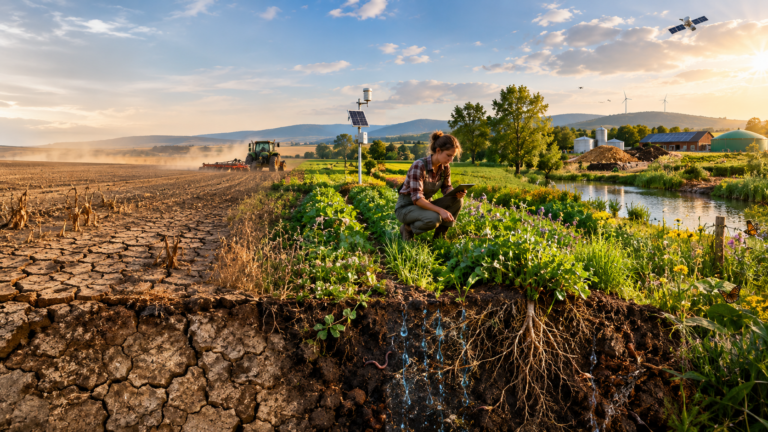
Europe is currently facing a triple planetary crisis – climate change, pollution and biodiversity loss. Land degradation is affecting 60 to 70 % of agricultural land in the EU, with increasing weather extremes and disrupted water cycles directly threatening farmers' yields and incomes. The European Economic and Social Committee (EESC) in its opinion NAT/948 stresses that overcoming this crisis requires a fundamental change of narrative: a shift to regenerative and circular agriculture, which not only maintains the soil and nature, but also actively restores it.
How regenerative and circular practices protect the climate
Regenerative agriculture combines sustainable management with circular economy principles, relying on natural biogeochemical cycles and the health of the soil microbiome instead of over-reliance on synthetic inputs.
- Carbon capture and emission reduction: Practices such as year-round soil coverage with cover crops and undersowing, no-till or shallow tillage, agroforestry, and the application of biological fertilizers increase year-round photosynthesis and pure primary productivity, making the soil an active reservoir that sequesters carbon dioxide from the atmosphere.
- Significant input savings and higher efficiency: Practical and scientific knowledge confirm that regenerative systems can increase crop yields by up to 15 %, while at the same time reduce synthetic nitrogen consumption by 23 % and fuel consumption by more than 75 %.
- Restoration of the water cycle and resistance to extremes: Better soil structure increases its ability to retain water. This restores natural water cycles, protects the landscape from floods and fires, improves groundwater management, and increases drought resistance.
- Circular Food Hubs: Linking regenerative agriculture with a circular bioeconomy creates a market for secondary outputs (e.g. catch crops, unusual cereals or agroforestry products) through the innovative development of new food products.
A unified definition based on results
There are currently over 100 different definitions of regenerative agriculture on the market. The EESC therefore proposes a common operational definition for the EU, to avoid misleading commercial practices ("greenwashing") or privatisation of the concept.
EESC definition: „Regenerative agriculture is agriculture that is characterized by an adaptive and holistic approach, applying practically proven and scientifically based methods with a positive impact on the environment, the livelihoods of farming communities and the health of the population, and which ensures the resilience of yields, competitiveness and social outcomes.“
The EESC stresses that regenerative agriculture does not represent a rigid list of prohibited or restricted activities, but adaptive system driven by measurable results. At the same time, it does not compete with organic farming or agroecology, but creates an inclusive framework for pragmatic cooperation of the entire agri-food sector.
Measurable indicators (KPIs) and modern technologies
In order for farmers to be fairly rewarded for regenerative practices, a harmonised data language and clear key performance indicators (KPIs) are needed:
- Short-term indicators (annual): They are evaluated without increasing the bureaucratic burden at the level of individual hectares using Copernicus satellite remote sensing. They mainly monitor absolute and relative year-round photosynthesis, year-round soil coverage a plant diversity.
- Long-term indicators (every 4 years / crop rotation): They are detected through accurate soil tests in situ. They measure total soil organic carbon (SOC), bulk density, pH, nutrient availability and soil biodiversity.
Recommendations for EU and CAP policies after 2027
For farmers to successfully transition to regenerative models, the EESC recommends the adoption of the following systemic measures:
- Reform of CAP payments: Explore the alignment of both direct payments (Pillar 1) and rural development (Pillar 2) with KPI results derived from Copernicus satellite data. Farmers should be rewarded for their environmental performance and should not be penalized in the event of failure caused by uncontrollable climatic fluctuations.
- Financial and investment support: Provide subsidies and tax breaks for the purchase of innovative technology (e.g. machines for direct sowing without tillage), preferential loans and targeted conversion insurance systems, which cover risks during the first years of transition.
- Synergy with EU legislation: Align regenerative agriculture KPIs with the Sustainability Reporting Directives (CSRD, CSDDD), the Water Framework Directive, LULUCF legislation and the EU Taxonomy.
- Supply chain and access to land: Incorporate KPIs into contracts with processors and retailers, promote green public procurement, and ensure more favorable terms for renting and purchasing land for young farmers and restoration pioneers. JRi&CO2AI

