 ICLEI - Local Governments for Sustainability is a global network of more than 2,500 local and regional governments engaged in sustainable urban development. We operate in more than 125 countries, influencing sustainability policy and supporting local measures in favor of low-emission, natural, fair, resilient and circular development. We bring sustainability to the rapidly developing urban world. ICLEI makes sustainability an integral part of urban development and creates systemic change in urban areas through practical, integrated solutions. We help cities, towns and regions anticipate and respond to complex challenges, from rapid urbanization and climate change to ecosystem degradation and inequality. Local and regional governments in our network are meeting these challenges by integrating sustainability into everyday operations and policies. We invest in the capacity and knowledge needed to design solutions and make decisions based on data, scientific evidence and local realities and pressures. Our five pathways to low-emission, natural, equitable, resilient and circular development are designed to create systemic change. We work in cities, towns and regions of all sizes, with different capacities and challenges. Many of them have set and achieved ambitious goals and are at the forefront of sustainability, pioneering new solutions and challenging the status quo. Others are taking the first steps towards transformation, strengthening their systems and capacities to achieve sustainability goals. Around the world, ICLEI brings the latest global knowledge and solutions to the local context.
"by clicking on the title of the article, you will be redirected to the entire article"
 EN
EN  SK
SK 

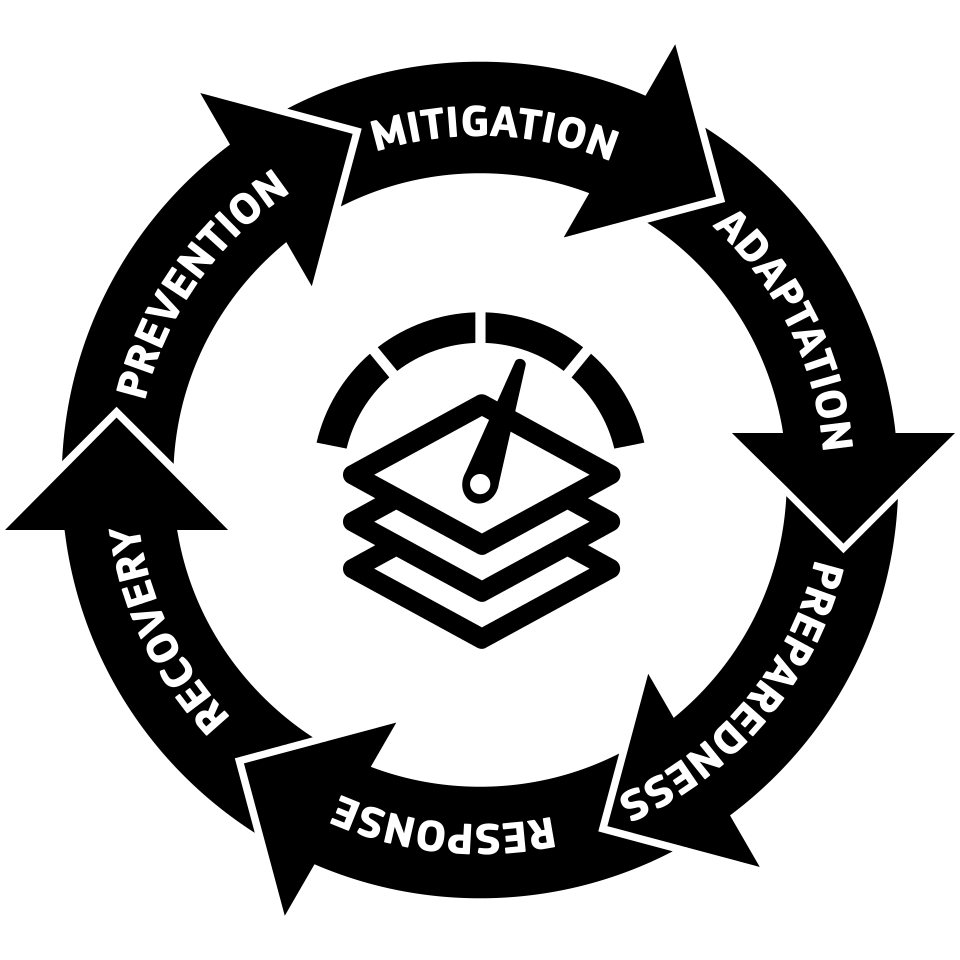 DRMKC brings together different departments of the European Commission, European countries and the entire disaster community with the aim of managing disaster risk in a more coordinated manner. Increased effectiveness of better coordinated policies based on knowledge transfer between sectors. The goal of DRMKC is to integrate and consolidate existing scientific multidisciplinary knowledge with the aim of joint development of innovative solutions for existing needs.
 Climate.gov The health, safety, and economic well-being of Americans are closely related to climate and weather. People are looking for information to help them understand the climate and decide how to manage climate-related risks and opportunities. To meet this need, NOAA Climate.gov provides up-to-date and credible scientific data and information on climate science, adaptation, and mitigation. Our goals are to promote public understanding of climate science and climate-related events, facilitate access to and use of NOAA data products and services, provide climate-related support to the private sector and the national economy, and serve people who make climate-related decisions , using tools and resources to help them answer specific questions. In short, the mission of NOAA Climate.gov is to provide science and information for a climate-smart nation.
 The Institute of Environmental Policy (IEP) is an analytical unit of the Ministry of the Environment of the Slovak Republic (MŽP SR). Our mission is to provide high-quality and reliable analyzes and forecasts in the field of the environment for the Slovak government and the public. The objectivity of the IEP is ensured by its independence. The outputs do not necessarily reflect the official views of the Ministry of the Interior of the Slovak Republic, their goal is to stimulate and improve professional and public debate on current topics. IEP is led by a former long-time IFP analyst and the average age of IEP analysts is 32 years. We have been cooperating with foreign organizations for a long time, as part of which we implemented and continue to implement joint projects in cooperation with the OECD or the World Bank, in which our analysts were sent for several weeks directly to the given organization.
 The Institute for European Energy and Climate Policy (IEECP) is a non-profit, independent research organization. We act as a knowledge hub that shares pragmatic results as well as innovative ideas, providing policymakers and all private and public decision-makers with independent expertise and science-based research to support their energy transition and sustainable future efforts. The Institute for European Energy and Climate Policy (IEECP) is a non-profit, independent research organization. We act as a knowledge hub that shares pragmatic results as well as innovative ideas, providing policymakers and all private and public decision-makers with independent expertise and science-based research to support their energy transition and sustainable future efforts.
 NASA's global climate change website is produced by the Earth Science Communications team at the NASA/Caltech Jet Propulsion Laboratory. To learn more, visit our website.
 The European Platform for Adaptation to Climate Change Climate-ADAPT is a partnership between the European Commission and the European Environment Agency (EEA). Climate-ADAPT is managed by the EEA with the support of the European Topic Center on Climate Change Impacts, Vulnerability and Adaptation (ETC/CCA).
 IPCC WGI Interactive Atlas