 EN
EN  SK
SK 

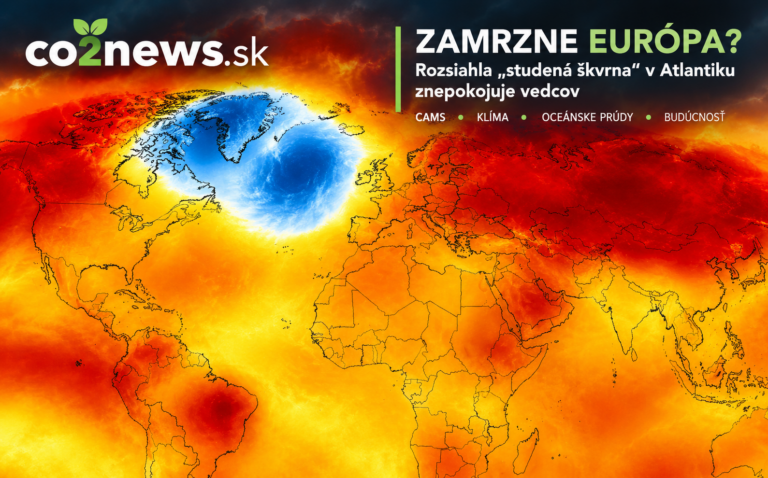
While virtually the entire world is warming significantly due to human-caused climate change, there is an area in the North Atlantic south of Greenland and Iceland that is bucking the trend and is even cooling. This unusual ocean phenomenon, called by experts „"cold spot"“ (cold blob) or „"heating hole"“ (warming hole), is worrying climatologists around the world. The reason is not only the drop in temperatures in this part of the ocean itself, but especially what this phenomenon signals: a slowdown in a key ocean system AMOC (Atlantic Meridional Overturning Circulation), which acts as a giant natural radiator for all of Europe.
Oceanic conveyor belt and the formation of a cold spot
The mild winters, abundant rainfall and stable climate that we are used to in Western and Central Europe are not a given. They are the result of a delicate balance maintained by the Atlantic current system. The AMOC transports warm and salty water from the tropics northwards. During this journey, the water transfers its heat to the atmosphere, warming the European continent. When the warmed water reaches the subpolar regions, it cools, becomes denser and heavier and sinks to the depths of the ocean, from where it flows back south. Scientists compare this closed cycle to a huge ocean conveyor belt.
In recent decades, measurements have shown that this system is starting to weaken. An extensive analysis of the temperature and heat content of the ocean published by a team led by Professor Stefan Rahmstorf confirmed that the formation of the cold spot is not caused by changes in the heat flow at the surface of the atmosphere, but by a direct decrease in the horizontal heat transport by the ocean currents themselves. The currents are simply bringing less heat to the North Atlantic than in the past.
The main driver of this slowdown is the massive melting of the Greenland ice sheet and Arctic ice. As the melt progresses, huge amounts of fresh water are being pumped into the North Atlantic. Fresh water is less dense than salty seawater, which prevents the cooled water from sinking to deeper layers. This process gradually chokes the engine of the entire ocean conveyor belt.
Is Europe in danger of a sudden collapse and the arrival of a new ice age?
The question of whether the AMOC circulation will completely collapse and when this might happen is a subject of lively debate in the scientific community. In 2024, dozens of the world's leading climate scientists wrote an open letter to the Nordic Council of Ministers warning that the risk of ocean circulation collapse has been significantly underestimated. The scientists point out in the letter that the AMOC is currently at its weakest in a millennium and that the breaking point (tipping point) is threatening to happen already this century, or it may start now with catastrophic consequences in the coming centuries.
The latest simulations of the CMIP6 climate models suggest that the breakdown of the AMOC circulation could occur between 2055 and 2063 under high and medium emissions scenarios. On the other hand, a study by experts from the UK Met Office and the University of Exeter indicates that a complete cessation of the flow by 2100 is less likely, because the circulation is partly maintained by wind drive in the Southern Ocean around Antarctica. However, these authors also emphasize that the weakening of the AMOC itself will bring major climate impacts that cannot be underestimated.
What would an AMOC collapse mean for European weather?
Movie scripts of the type The day after tomorrow, where a new ice age will occur in a few days, are of course exaggerated. However, the real impacts of a collapse or significant weakening of the AMOC on European climate would be drastic.
A study by researchers at Utrecht University, led by Dr. René van Westen, examined a scenario in which the AMOC collapsed in a world warming by 2°C. The results showed that regional cooling caused by ocean heat loss would completely outweigh global warming caused by greenhouse gases in northwestern Europe.
The most significant impacts would include:
- Extremely cold winters: Average winter temperatures in northern and western Europe would drop by 10 to 30 °C. In London, frosts in winter extremes could approach -20 °C and in Scandinavian Oslo up to -48 °C.
- Sea ice expansion: In the winter months, sea ice would extend to the coasts of Scandinavia and Great Britain, further intensifying the cooling effect of reflected sunlight.
- Huge seasonal fluctuations: While winters would be reminiscent of an ice age, summer temperatures would remain only slightly cooler or comparable to today, creating an extreme temperature jump between seasons.
- Storms and droughts: The increased temperature difference between the cooler northern and warmer southern Europe would trigger more intense storm activity. At the same time, a shift of tropical rainfall belts to the south is expected, which would cause a decrease in summer rainfall and the occurrence of drought in Europe.
These changes would have a devastating impact on agriculture, energy infrastructure, water supplies, and marine ecosystems.
Are we on the verge of a tipping point?
The research clearly confirms that the ocean is not just a passive backdrop to global climate, but an active regulator of it. Although the exact timing of a potential collapse remains a matter of scientific debate, the existential risk associated with the slowing of the AMOC is real.
As climatologists emphasize, adapting to such a drastic climate shock in Europe is not a realistic option. The only effective solution is a radical and rapid reduction in global greenhouse gas emissions to keep global warming as close as possible to 1.5°C and avoid crossing the critical tipping point in the Atlantic. JRi&CO2AI
Co2AI can make mistakes. Check important information.

