 EN
EN  SK
SK 

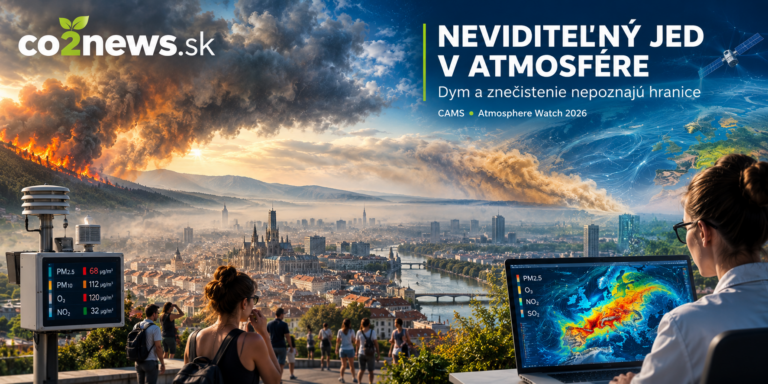
The year 2026 will go down in history as a particularly worrying milestone in the state of the Earth's atmosphere. Scientific findings published in report Atmosphere Watch 2026, developed by the European Union's Copernicus Atmosphere Monitoring Service (CAMS) under the leadership of The European Centre for Medium-Range Weather Forecasts (ECMWF) paints a stark picture of the link between the climate crisis and air pollution. According to the World Health Organization (WHO), up to 99% of the world's population lives in areas where pollution levels exceed health limits, leading to more than 4 million premature deaths each year. Extreme heat waves, widespread forest fires and massive desert dust movements this year have once again shown that atmospheric toxins respect no national borders, endangering millions of people thousands of kilometres from their source.
Ground-level ozone: A silent toxin that ignores borders and legislation
While emissions of many traditional pollutants are falling in Europe thanks to strict regulations, ground-level ozone poses an unmanageable and growing threat. Unlike the protective ozone in the stratosphere, ground-level ozone is a secondary pollutant that is formed by photochemical reactions between nitrogen oxides from fossil fuel combustion and volatile organic compounds in the presence of sunlight and high temperatures. The year 2026 revealed the frightening extent of the problem: up to 40 % of the world's population were exposed to extremely high levels of ozone pollution. In Asia, this proportion even reached 60 % of the population. Globally, up to 50 % people were exposed to very poor or extremely poor air quality due to ozone, while only a meager 5 % of the world's population breathed air with good ozone levels.
Rising global temperatures and repeated summer heatwaves create ideal conditions for ozone accumulation, directly undermining the effects of policies aimed at reducing emissions. There is a significant north-south dispersion in Europe, with southern countries regularly failing to meet the targets of the EU Air Quality Directive. A detailed CAMS analysis of the Italian city of Bergamo during the July 2026 heatwave showed that hemispheric transport of ozone through air currents plays as important a role as all European anthropogenic sources combined. This means that no country can tackle this invisible poison with isolated local measures.
Forest fires: From local devastation to continental toxic fog
The year 2026 was also marked by the unprecedented intensity and scale of forest fires, which turned local natural disasters into continental air quality crises. Although the total area of burned areas has decreased globally in recent decades, human exposure to fire smoke has increased by 40 % over the past two decades due to higher fire intensity due to climate change and population growth in vulnerable areas. Forest fire smoke releases fine dust particles PM2.5, nitrogen oxides, greenhouse gases and ozone precursors into the air, which significantly worsen human health.
In Europe, fires in the French regions of Gironde and Landes burned almost 50,000 hectares of forest and forced the evacuation of 40,000 people, one of the largest evacuations in France since World War II. In Spain, fires in the provinces of Ávila and Madrid burned more than 50,000 hectares, forced the evacuation of 56,000 residents and forced 30,000 people to stay indoors, while carbon emissions reached record levels since 2003. Belgium experienced the largest fire in the High Fens in a century, with toxic smoke plumes traveling through Germany and into Poland.
North America faced massive wildfires in Canada and the western United States, blanketing much of the continent in thick smoke and triggering air pollution warnings from Chicago to Philadelphia. The smoke plumes crossed the Atlantic Ocean, reaching Europe, the Arctic and even Greenland, increasing PM2.5 concentrations thousands of kilometres away. In Southeast Asia, the onset of the El Niño phenomenon, combined with hot, dry weather, caused intense fires in Indonesia, particularly on the island of Borneo and in the provinces of West and Central Kalimantan. Local peatlands released huge amounts of smoke, exposing residents to dangerous concentrations of PM2.5 particles of up to several hundred µg/m³.
Global travelers and deepening health inequalities
In addition to ozone and smoke from fires, desert dust plays a key role in atmospheric pollution, with approximately 2 billion tons of it entering the air each year. In 2026, Saharan dust repeatedly moved across the Mediterranean Sea to Europe and across the Atlantic to the Caribbean, increasing concentrations of PM10 particles. European cities such as Las Palmas, Santa Cruz de Tenerife, Valletta and Córdoba experienced dozens of days of warnings of extreme dust storms.
The impacts of this global pollution on the human body are devastating: PM2.5 particles and ozone penetrate deep into the respiratory system and bloodstream, damaging virtually every organ in the body – from the heart and lungs to the kidneys and brain. The report’s findings also reveal deep global inequalities: while in high-income countries the mortality rate attributable to air pollution is 17 deaths per 100,000 inhabitants (21 in the EU), in South Asia the figure is a catastrophic 191 deaths per 100,000 inhabitants.
A challenge that can no longer be postponed
The 2026 CAMS report clearly shows that partial successes in reducing industrial emissions are not enough if we are not to stop climate change. The interplay between rising temperatures, extreme fires and the build-up of atmospheric toxins is creating a dangerous spiral. Unless the international community adopts a radical, coordinated global strategy, atmospheric poison will continue to cross borders unnoticed and take a cruel toll on human lives. JRi&CO2AI
Co2AI can make mistakes. Check important information.

