 EN
EN  SK
SK 

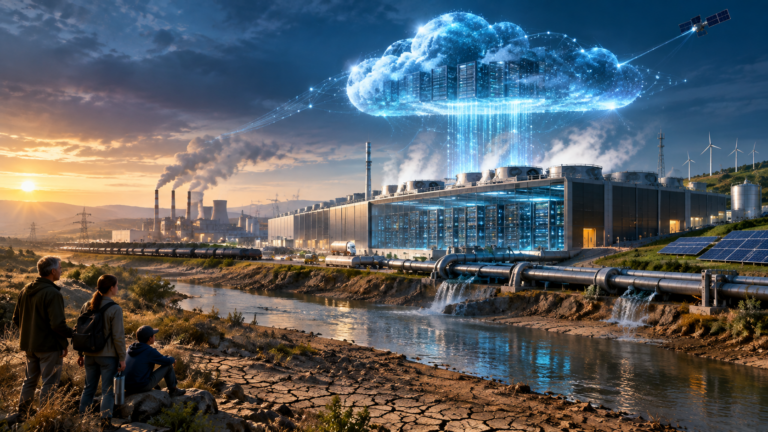
Artificial intelligence is often presented as an intangible software miracle that will solve the climate crisis and make the world more efficient. But behind this digital revolution is the most massive physical infrastructure in history – giant concrete data centers., which consume billions of liters of drinking water, overload power grids, and bring fossil fuel industries back into play. AI algorithmic code alone is not responsible for this state of affairs; the real threat to a sustainable future is the strategies, lack of transparency, and reckless expansion of big tech companies.
The invisible hydrological footprint: How a cloud dries out the hottest regions
One of the biggest, yet long-overlooked impacts of digital expansion is enormous water consumption. Data centers require water primarily on two levels: directly to cool overheating server arrays (Scope 1) and indirectly in the generation of the electricity they consume (Scope 2).
Direct on-site consumption mainly uses evaporative cooling towers, while up to 80 % of the water withdrawn is irreversibly evaporated. To prevent clogging of pipes and the formation of bacteria, the tech giants are overwhelmingly drawing fresh drinking water for their coolers:
- Billions of liters per year: In the US alone, data centers will directly consume 17.4 billion gallons (approximately 65.8 billion liters) of water in 2023. Globally, data center water consumption is estimated at more than 560 billion liters per year, and could increase to 1,200 billion liters by 2030.
- Consumption when training and using AI: Training a single GPT-3 model in Microsoft’s data centers evaporated 700,000 liters of drinking water on site, with a total water footprint (including electricity production) of 5.4 million liters. In use, the AI model consumes about half a liter of water for every 10 to 50 answers. A single query to the generative AI consumes 10 times more energy than a single Google search.
- Expansion in dry areas: While technology corporations declare sustainability goals, two-thirds of new US data centers built or planned as of 2022 are located in areas with high water stress. In Maricopa County, Arizona, which is facing an extremely dry spell, Google has a permit to draw 5.5 million m³ of water per year – equivalent to the consumption of 23,000 residents. In Aragón, Spain, Amazon plans to build three new data centers with a license to draw 755,720 m³ of water per year, while also requesting a 48 % increase in drawdown for its existing facilities.
At the global level, it is estimated that by 2027, water withdrawal for AI needs will reach 4.2 to 6.6 billion cubic meters per year – which represents the volume corresponding to half of the annual consumption of the entire United Kingdom or four to six times Denmark's annual consumption.
Fueled by Fossil Fuels: How Big Tech Is Obstructing Climate Goals
Besides water, the second key condition for the functioning of data centers is continuous and huge supply of electricity. The International Energy Agency (IEA) has identified AI-powered data centers as a major structural factor in the 4.3 trillion terawatt-hour increase in global electricity demand by 2024.
In the European Union, electricity consumption in data centers is expected to double by 2030. triples – from 62 TWh to more than 150 TWh, increasing their share of total European consumption from 2 % to 5 %. In Ireland, data centers are already cutting 18 % of the country's total electricity.
Instead of accelerating the transition to renewables, tech companies’ rapid growth has led to a reengagement with the fossil fuel industry:
- Gas and coal as a fuse: In the US, it is estimated that data centers by 2030 triple the demand for natural gas. Electricity demand for AI in the US will triple to about 300 TWh per year by 2028.
- A new market for the fossil fuel lobby: At a time when the globalized economy is trying to move away from fossil fuels, hyperscale data centers (along with plastics production) represent a new, lucrative market for the coal and gas industries, guaranteeing them demand for decades to come.
- Emissions at the level of entire countries: It is estimated that within four years, data center infrastructure will add emissions equal to the total emissions of Japan – the sixth largest polluter in the world.
- Not algorithms, but corporate strategies: Myths, greenwashing and misinformation
So if AI itself does not have a physical body, why are tech companies responsible? Because it is the corporate management of Big Tech companies (Amazon, Microsoft, Google, Meta) that chooses the path of aggressive expansion without regard for local communities and ecosystems.
Investigations and case studies reveal three main patterns of corporate behavior:
- False myth about job creation: When negotiating land, companies promise municipalities hundreds of permanent jobs (e.g. 400 in Zeewold, Netherlands or 100 in Querétaro, Mexico). However, research shows that a single data center employs people directly on site upon completion. maximum 20 people.
- Greenwashing and deceptive certificates: Tech giants present their commitments like „"Water Positive by 2030"“. In practice, this means that instead of reducing water withdrawals in the beleaguered region, they fund compensatory water projects elsewhere in the world—a practice that experts and sustainability professionals alike call an unethical smokescreen. Similarly, they use renewable energy certificates (RECs/GOs) to claim their data centers are „100% green,“ even though they are physically powered by a grid that relies on coal and gas.
- Jevons' paradox: Current efforts to reduce the energy consumption of chips lead to the so-called "efficiency trap" - the cheaper and more efficient the calculation, the more massively the technology is deployed, which ultimately multiplies the overall resource consumption instead of reducing it.
Lack of transparency, non-disclosure agreements and community resistance
Data center construction is happening extremely quickly and behind closed doors. Tech companies often force local governments to sign off on non-disclosure agreements (NDAs). Practical examples show the depth of non-transparency:
- In the Netherlands, Meta performed at the project „"Operation Tulip"“ under a shell company „"Polar Networks"“, to conceal its intention from the public.
- In Mexico, Microsoft purchased water concessions through intermediaries, thereby masking the real volume of water consumed.
- At the global level only 40 % data center operators actively track and publish their water consumption metrics.
A wave of civil resistance is rising around the world in response to the drying up of groundwater and rising energy prices. An initiative has emerged in Spain „"This Cloud Drys My River"“ („Your sky/cloud is drying up my river“). In Chile, the organization MOSACAT forced Google to reconsider water projects, and in the Netherlands, citizen resistance led to the halt of a Big Tech mega-project.
As activist Aurora Gómez aptly summarized: „"Neither people nor data can live without water. But human life is essential, while data is not."“.
Who will decide our future?
The growing AI infrastructure presents society with a fundamental choice: either we will have a stable climate and protected water resources, or the uncontrolled expansion of data centers dependent on fossil fuels.
The solution is not to completely reject artificial intelligence, but strict regulation and application of sufficiency principles at national and EU level:
- Legally binding limits: Introducing mandatory and locally specific reporting of water and energy consumption for all data centers.
- Prioritizing social value: Prioritizing computing power for meaningful purposes (e.g. medical research, climate modeling, or flood prediction) over non-essential applications such as generating mass spam or personalized advertising.
- End of exemptions for Big Tech: Banning the construction of water- and energy-intensive centers in areas facing water stress and drought.
If we don’t let tech corporations dictate the rules of the game at the expense of the environment, AI can serve as a useful tool. But if we give them free rein, their hunger for energy and water will take over our shared future. JRi&CO2AI

