 EN
 SK


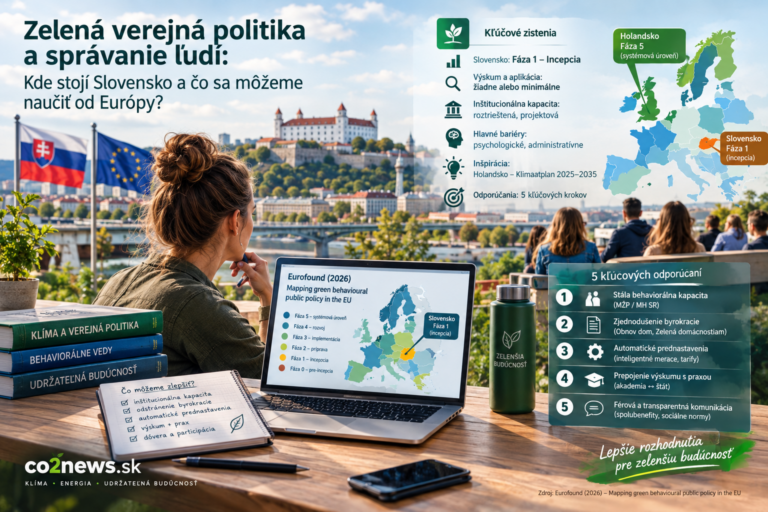
This overview report is based on studies European Foundation for the Improvement of Living and Working Conditions (Eurofound, 2026) entitled „"Mapping green behavioral public policy in the EU"“. The report provides an in-depth analysis of institutional maturity, psychological barriers and strategic challenges faced by the Slovak Republic in applying behavioral insights (BI) in the field of environment and climate policy.
1. Assessment of Slovakia's institutional maturity
In the pan-European mapping of the capacity and application of green behavioural public policy (GBPP), Slovakia included in Phase 1 – Inception.
- Research capacity and application: The official research capacity in the field of green behavioral sciences and their application in state environmental policy are evaluated as „"None or minimal", while the overall national trend remains horizontal and stable in the long term.
- Institutional structure: In 2019, a unit was established within the Office of the Deputy Prime Minister of the Slovak Republic Behavioral Research and Innovations Slovakia. Its primary mission was the digitalization of public administration and the simplification of state-citizen communication; the unit did not address climate or environmental issues.
- Academic capacities: The academic background is represented, for example, by the Institute of Public Policy of Comenius University in Bratislava, which has carried out partial research focused on littering prevention or interventions within the project. Green schools.
- Overall assessment: The application of behavioral knowledge in Slovakia remains fragmented, project-based, and lacks permanent, systematic integration into the legislative and subsidy processes of the environmental ministry.
2. Regional context: The gap between North-West and Central Europe
Slovakia is part of a significant geographical imbalance within the European Union. As many as 17 out of 28 countries surveyed are in Phase 0 (pre-inception) or Phase 1 (inception).
- Neighborhood cluster: Slovakia forms a homogeneous group with the countries of Central and Eastern Europe (Czech Republic, Poland, Hungary, Bulgaria, Romania, Croatia, Slovenia), which are exclusively in Phase 0 or 1.
- Just transition risk: Regions with high dependence on coal and ongoing difficult structural transformation have the lowest institutional capacities for policy-making focused on human behavior. This means that states with the highest social costs of transformation risk having the fewest tools to make them more effective.
- Dependence on EU projects: For the vast majority of countries in Phase 1, participation in EU-funded projects is the only trigger for research. However, after the grants end, the initiatives cease to exist because permanent domestic institutional units are not established.
3. Psychological and administrative barriers of Slovak households
Traditional tools such as widespread information campaigns or economic sanctions are ineffective due to specific psychological and administrative barriers:
- Value-action gap: Although 84% of EU citizens acknowledge the human origin of climate change, the concerns expressed do not automatically translate into sustainable daily habits.
- Mental load (Bandwidth tax): Financial stress and poverty consume most of individuals' cognitive capacity to deal with immediate needs (rent, food), leaving them with no capacity to plan long-term investments in home renovations or energy equipment changes.
- Administrative friction (Sludge): Complicated forms, unclear conditions and bureaucracy discourage citizens from drawing on state subsidies. An example from Cyprus showed that more than 55 % vulnerable households did not receive available grants for renewable sources precisely because of the administrative complexity of the process.
- Present bias and Status quo bias: People systematically place more weight on immediate costs and convenience than on future financial savings, and they tend to stick to routines.
- Pluralistic ignorance: Citizens significantly underestimate the extent to which their neighbors and fellow citizens support environmentally friendly behavior and green legislation, which creates the impression that "no one else has acted," thereby weakening their own willingness to join in.
4. System inspirations for Slovak practice (Klimaatplan 2025–2035)
According to the European Commission's 5-level framework, most European countries focus only on partial interventions (individual nudges at levels 1 and 2). A leading example for Slovakia is the Netherlands (Phase 5), which operates on system level 5 through the national climate plan Climate plan 2025–2035:
- Four principles of justice: The Dutch model is based on intergenerational justice, fair burden sharing (higher emitters bear a larger share), financial justice (subsidies must not only serve the rich), and market justice.
- One-stop-shops: Instead of requiring citizens to study complex legislation, the state is creating integrated contact points for home insulation and renovation, which reduce the administrative burden and save citizens' mental capacity.
- Trust and participation: Building trust through transparent pre-bunking strategies and involving citizens through citizens' assemblies increases the legitimacy of the measures taken.
5. Recommended steps for public policy makers in Slovakia
For Slovakia to successfully move from Phase 1 to higher stages of maturity, the Eurofound report recommends the following measures:
- Creating permanent behavioral capacity: Move from ad-hoc projects to establishing a permanent behavioral team at the Ministry of the Environment of the Slovak Republic or the Ministry of Economy of the Slovak Republic with permanent funding.
- Systematic removal of bureaucracy ("de-sludging"): Revise national subsidy schemes (e.g. Renovate the house whether Green for households) to simplify the application process and eliminate barriers for low-income households.
- Implementing automatic defaults (Defaults): Use automatic ecological presets (e.g. in smart meters or standard energy tariffs) that do not require high mental effort from citizens.
- Linking research with legislative practice: Create permanent communication and implementation channels between academic departments (e.g. the Office of Academic Affairs of Comenius University) and state authorities.
- Fair and transparent communication: Focus communication on salient co-benefits (savings, health, quality of life) and building social norms instead of simply scaring people about the climate crisis. JRi&CO2AI

