Main newsSponsored byMost read
Discover

Emission compensations

The emissions compensation system allows compliance flexibility for facilities regulated under TIER. Emission offsets are generated by projects that have voluntarily reduced their greenhouse gas emissions. Emission offsets are quantified using Alberta-approved methodologies called quantification protocols and are third-party verified in accordance with the Validation, Verification and Audit Standard. Offset projects must meet the requirements of the Technology Innovation and Emission Reductions Regulation (TIER) , the Standard for Greenhouse Gas Offset Project Developers and the relevant Alberta-approved quantification protocol. Emission offsets in Alberta are registered and publicly listed on the Alberta Emission Offset Registry, which is currently operated by CSA Group.

"by clicking on the title of the article, you will be redirected to the entire article"


Global X Unveils Carbon Credit ETF Strategy

Global X bolstered its lineup of exchange-traded funds on Thursday with the addition of the Global X Carbon Credits Strategy ETF ( NYSEARCA: NTRL ). NTRL's objective is to provide investors with access to carbon futures in various geographic regions to limit emissions in line with the 2015 Paris Agreement. NTRL takes long positions in futures contracts that involve the physical delivery of emission allowances issued under cap and trade regimes. Global X highlighted that global expectations of tighter emission limits have led to demand for carbon quotas around the world. The ETF issuer noted that between 2018 and 2022, the total value of regulated carbon markets more than quadrupled, from $186 billion to $856 billion. "Pressure to meet emissions reduction commitments under the Paris Agreement is intensifying and regulators around the world are seeking to tighten emission caps, potentially increasing the scarcity and price of carbon allowances," said Pedro Palandrani, director of research at Global X ETF. Additionally, NTRL comes with a 0.39% expense ratio. NTRL will also find itself trading alongside other ETFs focused on carbon credits, such as the KraneShares Global Carbon Strategy ETF ( FIREPLACE ), KraneShares California Carbon Allowance Strategy ETF ( KCCA ) and KraneShares Global Carbon Offset Strategy ETF ( KSET ).

CEO of biggest carbon credit certification body resigns after claims offsets worthless

The head of the world's leading certifier of carbon credits has announced that he will step down as CEO next month. It comes amid concerns that Verra, a Washington-based nonprofit, approved tens of millions in worthless offsets used by major companies for climate and biodiversity commitments, according to a joint investigation Guardian earlier this year. Vo statement on LinkedIn on Monday, Verra CEO David Antonioli said he would step down from his role after 15 years leading the organization that dominates the $2 billion voluntary carbon market, which has certified more than 1 billion credits through its Verified Carbon Standard (VCS). .

(Patrick Greenfield)

JPMorgan agrees to buy $200 million in carbon removals

KEY POINTS
  • JPMorgan Chase announced Tuesday that it has agreed to spend more than $200 million on a combination of carbon removal technologies.
  • $75 million of the $200 million was announced in April when JPMorgan announced it was joining Frontier.
  • Overall, the decarbonization investment and long-term contracts with decarbonization companies represent a step to support the still-emerging decarbonization industry and allow the bank to remove the equivalent of carbon emissions that are otherwise difficult to reduce from its sources. direct operations by 2030, JPMorgan said. (Catherine Clifford)

'Offset' is not a dirty word! Promoting voluntary carbon markets

“I've been wondering something lately: when did 'offset' become a swear word? Should I write it as off***? The extent to which offsets are downplayed in much of the decarbonisation debate concerns me, not just me. Offsets are an integral part of any sensible net zero strategy. Without offsets, it is not possible to achieve a net reduction of emissions to zero. However, it seems to be increasingly suggested that offsets should be reserved exclusively for the period when all other decarbonisation options have been exhausted and only residual emissions remain. It seems that then and only then is it acceptable to use them.” Why the Anti-Offset Logic Is Flawed There is a huge flaw in this approach. The term "buying offsets" may be distracting people from what is actually being done - that is, using offsets to direct capital to climate projects and initiatives. If we are to ensure that global warming does not exceed 1.5°C by 2050, we desperately need to decarbonize as quickly as possible and invest in long-term climate solutions. It's not one or the other - it's both, and they should be done in parallel, not sequentially. Buying offsets is essentially a way to invest in climate solutions that are otherwise not commercially viable (or you would just regularly invest alongside your assets to get a return on investment). And more often than not, many of the hardest to monetize opportunities are nature-based solutions like soil and peatland conservation, forest restoration, ocean protection, etc. If we don't support investment in this vital work, natural habitats around the world will pay the price.”

Mapping and AI applications suggest that stopping forest management is not enough to offset carbon emissions

A team of atmospheric and climate scientists from several institutions in Europe found that even if all human management of forest land stopped immediately, it would not be enough to offset global carbon emissions. In his study, published in the journal Science , the group used mapping and AI applications to model the extent to which such a plan would result in forest regrowth, and thus CO2 sequestration. 

For several years now, many large corporations have been trying to manage their own carbon footprint by doing business with carbon offsets and credits, while paying others to engage in activities that remove CO 2 from the atmosphere, they theoretically compensate for the emissions they emit. The biggest customers in such stores are those who manage large forests, such as parts of the Amazon. However, researchers say there is a flaw in this system – reusing the land as a forest will not be enough to overcome the problem of climate change (by Bob Yirk, Phys.org)

Carbon offsets - What role do they have to play in the race to reach net zero?

In 2019, only 16 % of the global economy was estimated to be covered by net zero targets, increasing to 68 % by 2021.

ESG investing is falling in popularity among UK investors

However, not all net zero pledges are created equal and we as investors have a role to play in examining the viability of the targets our investee companies have set themselves to ensure they are playing their part in the fight against climate change. While there is no single definition of net zero and no single framework for measurement, the Science-Based Targets Initiative (SBTi) has published the following definition of corporate net zero in its guidance:

  • Reducing scope 1, 2 and 3 emissions to zero or to a residual level consistent with achieving net zero emissions at the global or sectoral level in eligible 1.5°C aligned pathways
  • Neutralization of any residual emissions in the net-zero target year and all greenhouse gas emissions released into the atmosphere after that year

The first point in the definition, while not without problems, is the clearer ambition for many companies and will have the greatest short-term impact on emissions.

Many of the companies we speak to have been able to carry out initial assessments of their carbon footprints and have used these to set preliminary targets that will see substantial reductions in emissions in the short term. (Amelia Overd)

Advertisements claiming that products are carbon neutral, taking advantage of the UK offset ban

Ads that claim products are carbon neutral using offsets are to be banned by Britain's advertising watchdog unless companies can prove they actually work, the Guardian can reveal, as Gucci becomes the latest company to wrestle with a high-profile green commitment based on offsetThe Advertising Standards Authority (ASA) is to begin tougher enforcement of the use of terms such as "carbon neutral", "net zero" and "nature positive" amid growing concerns that companies are misleading consumers about the environmental impact of their products. part of a crackdown on greenwashing later this year following a six-month review. Under the plans, the ASA will take action against firms that tell consumers they can buy their products without worsening global warming or loss of nature on the basis of purchase offsets - unless they can prove they are actually effective. The move follows the ASA's recent enforcement of rights against Lufthansa companies a Etihad on ecological claims. Companies will still be able to talk about their sustainability efforts, the Guardian understands. (Patrick Greenfield)

Desperate about climate change? These 4 Charts About Solar's Unstoppable Growth May Change Your Mind

Last year, the world built more new solar capacity than all other energy sources combined. Solar energy is now growing much faster than any other energy technology in history. How fast? Fast enough to completely displace fossil fuels from the entire global economy before 2050. The rise and rise of cheap solar energy is our best hope for rapid climate change mitigation. Total solar capacity exceeded 1 terawatt (1,000 gigawatts) for the first time last year. The sector is growing by approximately 20 % per year. If this continues, we will reach 6 terawatts around 2031. In terms of capacity, this would be greater than coal, gas, nuclear and hydro combined. (Andrew Blakers)

Navigation in carbon credits

The carbon offset market has become a veritable minefield for organizations seeking to achieve net zero goals. With many offset schemes condemned as 'worthless', it is imperative that businesses find options that have real-world impact and use them strategically to avoid claims of greenwashing. The rapid growth of the carbon offset market, which is set to quadruple in size by 2020-21, has raised concerns that Australian organizations are using unreliable carbon credits to buy their way to net zero targets rather than making meaningful changes to decarbonise. Market analysis shows that carbon credits may not always deliver what is promised. As such, organizations need to educate themselves on how to ensure the most effective offsets for their decarbonisation journeys. The voluntary carbon market has soared to $2 billion in 2021, but not without criticism. A 2022 analysis revealed that more than 90 percent of rainforest carbon offsets from the world's largest certification body were "worthless" and called "phantom credits" that did not represent real carbon reductions.  This challenge to the integrity of carbon offsets, combined with increasing pressure on companies to prove they are decarbonizing, has created what you might call an imperfect storm. (Sandra Rossi)

Carbon capture can help the environment, but only if it's done safely

Because of Illinois' unusual geology, many companies across the country might want to capture carbon dioxide emissions from their operations and transport the gas to Illinois for sequestration underground. Before that happens, Illinois should implement strong safeguards to protect residents, landowners, taxpayers, drinking water and the climate. New federal subsidies support the use of technologies to capture and store the carbon dioxide released when fossil fuels are burned. This technology allows the gas to be stored thousands of feet underground to keep it out of the atmosphere, where it would help raise global temperatures. Archer Daniels Midland Co. in Decatur has been operating the nation's first carbon sequestration project for more than a decade, and more are planned elsewhere. But for a carbon sequestration network to cause a significant drop in carbon dioxide emissions, it would have to be exponentially larger than the ADM network. (Editorial board  CST)

Floating Concentrated Photovoltaic Thermal System for Carbon Capture

Norwegian research firm Sintef and Norwegian floating PV specialist Svalin Solar are currently developing a floating concentrating photovoltaic thermal (CPVT) receiver for use in carbon capture facilities. "The energy requirement for CO2 removal is perhaps the most dominant factor driving solvent-based post-combustion capture technology," he told magazine pv chief business developer company Sintef Martin Bellmann. "Essentially, any technology that significantly reduces the so-called reboiler duty - energy consumption for CO2 stripping - is in high demand." Both companies described the new technology as a solar carbon capture system that either fully or partially generates the thermal energy needed to separate the gas. "The proposed CPVT design is a single-axis 'linear pass' tracking system where rows of curved mirrors are mechanically rotated so that the longitudinal direction of the mirrors is always parallel to the incident sunlight and follows the daily motion of the sun," added Bellmann. "Concentration ratios of around 10 suns are possible." The CPVT receiver is based on a pipe on which the solar cell strips are attached. The small area of the CPVT receiver allows the use of highly efficient PV cells. "Although these photovoltaic cells are more expensive, the cost can be offset by the smaller area required," explained Bellmann. “Conventional crystalline silicon and multi-junction cells need to be considered. Then the price/performance ratio will be assessed once the prototype is put into operation and we have collected enough data from the test trials. (

Carbon capture can help the environment, but only if it's done safely

Because of Illinois' unusual geology, many companies across the country might want to capture carbon dioxide emissions from their operations and transport the gas to Illinois for sequestration underground. Before that happens, Illinois should implement strong safeguards to protect residents, landowners, taxpayers, drinking water and the climate. New federal subsidies support the use of technologies to capture and store the carbon dioxide released when fossil fuels are burned. This technology allows the gas to be stored thousands of feet underground to keep it out of the atmosphere, where it would help raise global temperatures. Archer Daniels Midland Co. in Decatur has been operating the nation's first carbon sequestration project for more than a decade, and more are planned elsewhere. But for a carbon sequestration network to cause a significant drop in carbon dioxide emissions, it would have to be exponentially larger than the ADM network.

(Editorial board  CST)

NZ and Kazakhstan are the only countries in the world to offset 100 % emissions by planting trees

Along with Kazakhstan, we are the only country in the world that allows 100 percent of our fossil fuel emissions to offset all of our greenhouse gases by planting trees. Some believe that this puts us at a disadvantage to the rest of the world and harms our agricultural sector and rural communities. (Beef and Lamb CEO Sam McIvor joins Mike Hosking.)

The largest carbon capture facility in the world will store 9 million tons of CO2 per year

The NextGen CDR Facility, a collaboration between Swiss carbon finance consultant South Pole and Japanese conglomerate Mitsubishi Corporation, has announced the purchase of 193,125 tonnes of carbon dioxide removal (CDR) from three projects, producing the largest CDR portfolio in the world. The purchase represents 25 percent of all CDRs purchased to date and provides more than 1,000 years of CO2 storage after delivery, according to a South Pole press release released last week. With an average price target of $200/t, NextGen intends to make permanent CDRs available to corporate buyers, allowing for risk diversification through a portfolio approach. A number of technologies are represented in the portfolio removal carbon  , such as biomass carbon removal and storage, direct air capture and storage, improved weathering, high-temperature biochar and product mineralization. (Baba Tamim)

The first major carbon capture projects were groundbreaking at a test site in Wyoming

A carbon capture test site built at a coal-fired power plant in Wyoming in 2018 is finally ready to bring a pair of promising technologies from the lab to market. California-based gas separation developer Membrane Technology and Research and Japanese manufacturer Kawasaki Heavy Industries broke ground on their respective carbon capture test sites at the Wyoming Integrated Test Center during a ceremony Tuesday afternoon attended by some of the state's top energy sector figures and several Japanese diplomats. (ITC). Many of Wyoming's leaders believe carbon capture will be key to preserving the struggling coal industry, which is being squeezed out of the electricity market by lower-emissions and increasingly affordable alternatives. ITC doesn't look like much. It's an expanse of red dirt that looks more like a fenced-off parking lot than a world-class innovation center. But the establishment that began to take shape almost ten years ago under the then-Gov. Matt Mead - is one of the few places in the world where researchers can test projects that have worked well in the lab but are not yet mature enough to be installed in a power plant.

(Nicole Pollack)

A market with carbon offsets may not be the solution we would like it to be

Facts are a key element of informed decision-making. And not just any facts, the best facts that are most connected to reality are needed to make the best decision. One more thing: "alternative" facts only exist in alternate universes, so use them at your intergalactic peril. Verra, "the world's leading carbon standard for the fast-growing $2 billion voluntary [carbon] offset market," appears to have been doing this for years, The Guardian reported on January 18. According to the paper, the research found that "the more than 90 % (rainforest) offset credits wrapped by Verra and bought by green-lovers like Shell, Disney and Gucci "are likely to be 'phantom credits' and do not represent real carbon reductions." Specifically, this means that the "94 % credits" that Verra sold to "internationally renowned companies" had "no climate benefit" at all. Furthermore, The Guardian continued: “The threat to forests was overestimated by about 400 % for the Verra projects. Big Biz was not alone. Even angst-ridden grunge bands jumped on the CO2 bandwagon: Pearl Jam was among the "…organizations that bought Verra-endorsed rainforest offerings." The findings hit experts like Barbara Haya, director of the Berkeley Carbon Trading Project, like a hammer. After all, The Guardian reported, Haya "has been researching carbon credits for 20 years in the hope of finding a way to make the system work." "The implications of this analysis are huge," she told the paper. "Companies use credits to claim emissions reductions, when most of these credits do not represent emissions reductions at all." Huge, sure, but they mirror what others have found whenever forest carbon offsets are explored as a means of clearing the conscience of corporate CO2 creators. For example, when a ProPublica reporter dug into forest CO2 offsets four years ago, she found—spoiler alert—the same sorry results that The Guardian found earlier this year. (Alan Guebert, Farm and dairy)

What are agricultural carbon credits?

I often get calls from Nebraska crop and livestock farmers interested in carbon credits. This article provides basic information on what carbon credits are and how they work. Here are some frequently asked questions and information you need to know:

What are carbon credits? Carbon credits are created when farmers or ranchers increase the rate of carbon sequestration on their land by changing production practices or adding a new practice. A common example is adding cover crops or reducing tillage when growing row crops.

Who will buy my carbon credits? Probably a corporation that wants to reduce its carbon footprint – at least on paper – to meet corporate requirements or targets for reducing carbon dioxide emissions.

What can I get paid for my carbon credits? That depends on how many you generate. You can get a good estimate of your operation's carbon credit potential at the NRCS website comet-farm.com. One ton of stored carbon equals one carbon credit. Carbon credits have reportedly been selling for between $10 and $15 per ton recently. Producers in Nebraska likely get less than one ton of stored carbon per acre per year. The US average is 0.6 tons per acre per year.

How can I get my carbon credits to sell? You must cooperate with agricultural carbon company such as Agoro, Bayer, Cibo, ESMC, Nori and many others. After you sign a contract with them, they will work with you to implement practices that will lead to further carbon storage. Each carbon company usually has its own system for measuring and verifying carbon storage, such as soil sampling at the beginning and end of the contract period.

Are carbon credits traded? Not on the public exchange. Therefore, it is difficult to get up-to-date price information other than from the carbon companies.

What do I need to know before signing a carbon contract? Take the contract to your lawyer for a legal review. This cannot be overstated. There will be a lot of legal fine print in the contract and you need a lawyer to explain what all that fine print means. There is no "standard" carbon lease yet, and each company has its own. (David Aiken)

Controlling carbon offsets

Carbon offset schemes faced new scrutiny as the governing body for the voluntary carbon market issued new quality standards. Concerns have also been raised about an offset project in the Peruvian Amazon used by major oil companies and Shell's rice paddy offset project. New quality standards for the $2 billion carbon offset industry were published at the end of March, the Guardian reported, after growing criticism that some projects are at best "greenwash" and at worst contributing to damage to livelihoods. environment and human rights violations. The new guidelines were announced by the Integrity Council for the Voluntary Carbon Market (ICVCM), an independent governing body, the Guardian reported. (The voluntary carbon market generally involves the sale of "carbon credits" generated by emission reduction projects, such as forest protection schemes, to companies that are net producers of CO2 emissions, such as oil companies. After purchasing the carbon credits, the companies claim that "offset" some of their own emissions.) Under ICVCM's new guidelines, carbon credit certification companies such as Verra, Gold Standard and the American Carbon Registry will have to "demonstrate how their credits were generated, demonstrate that they are a real reduction or elimination emissions using scientific methods, and follow rules on respecting the rights of indigenous and local communities", the Guardian reported. In an accompanying article, the Guardian reported: "If the industry can learn from recent events by increasing transparency and integrity, there is a chance that good practice can be built upon while bad practice is suppressed... That we cannot trade or compensate our way out of climate crisis, remains the most important message."

Offset implementation of the project

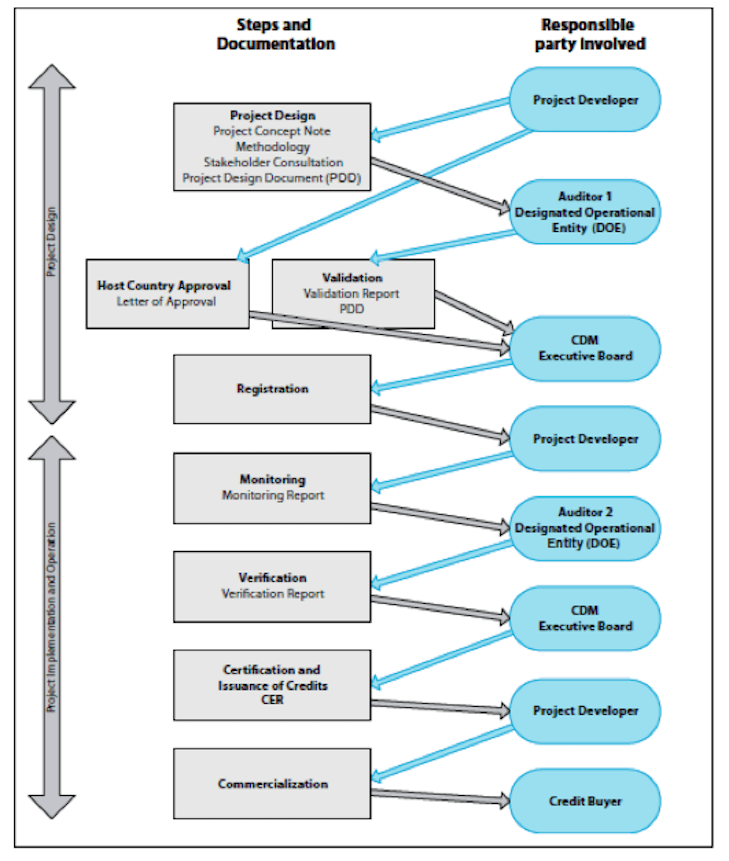
This section describes the offset project development process, from project design to commercialization, using the example of the Clean Development Mechanism (CDM). Although the project development process for projects implemented under voluntary offset standards may differ slightly from CDM procedures, the CDM project cycle is a useful frame of reference to outline a process that is generally similar across programs.

Project proposal

The project design phase includes the development of the project concept, the selection or development of the baseline and monitoring methodology, and consultation with stakeholders. All these elements are documented in the project proposal (PDD).

Project concept

A feasibility study of a potential offset project is conducted to assess its technical feasibility, investment requirements, development and operating costs, expected returns, administrative and legal hurdles, and project risks and pitfalls. Based on the results of the feasibility study, the project owner will decide whether or not to proceed with the development of the potential offset project.


Offset implementation of the project

This section describes the offset project development process, from project design to commercialization, using the example of the Clean Development Mechanism (CDM). Although the project development process for projects implemented under voluntary offset standards may differ slightly from CDM procedures, the CDM project cycle is a useful frame of reference to outline a process that is generally similar across programs.

CDM project cycle:
Project proposal

The project design phase includes the development of the project concept, the selection or development of the baseline and monitoring methodology, and consultation with stakeholders. All these elements are documented in the Project Design Document (PDD).

Project concept

A feasibility study of a potential offset project is conducted to assess its technical feasibility, investment requirements, development and operating costs, expected returns, administrative and legal hurdles, and project risks and pitfalls. Based on the results of the feasibility study, the project owner will decide whether or not to proceed with the development of the potential offset project.

Methodology

The offset project methodology defines the rules that the project proponent must follow to establish the project's baseline and determine the project's additionality, calculate emission reductions, and monitor parameters (e.g. electricity produced within the project) used to estimate actual emission reductions. It is a general recipe that can be applied to different projects of a given type (e.g. renewable energy production) and usage conditions (e.g. grid-connected). Within several programs, if there is no approved methodology for a specific type of project, the project developer can submit a new methodology for approval to the offset program (e.g. CDMthe gold standardVCS).

Project Design Document (PDD)

The project proposal document (PDD) describes the project activity in detail. It contains a description of the selected technology and explains the methodology used to define the baseline scenario, demonstrate complementarity and calculate emission reductions. It also contains information on the monitoring of all relevant technical parameters (e.g. temperature, gas flow, electricity generation, operating hours, etc.) including how to establish monitoring procedures, perform measurements, quality control and record keeping and access. It contains an estimate of the amount of emission reduction to be achieved by the project. Finally, it documents how the project contributes to sustainable development. The PDD is used throughout the implementation phase to ensure that the project will perform according to the parameters specified in the document.

Stakeholder consultation

KOs of offset projects under the CDM and most voluntary offset programs are required to provide evidence that project activities will not adversely affect local populations and other relevant stakeholders. To ensure that all relevant stakeholders are given the opportunity to comment on the proposed CDM project, the proponent must inform them about the project through appropriate forms of media. The contractor must respond to all comments from interested parties and describe the procedure for minimizing negative impacts. The results of stakeholder consultations must be documented in a project proposal document (PDD).

Project verification

Under the Clean Development Mechanism, project validation will be carried out by an independent third-party auditor approved by the UN. These auditors are called Designated Operating Entities or DOEs under the Clean Development Mechanism. The CDM project validation process usually consists of five phases:

  1. PDD administrative check,
  2. on-site visits and subsequent interviews with project stakeholders,
  3. 30-day period for public comments after making the PDD available via the Internet,
  4. resolution of unresolved issues and
  5. Final validation report issued and written by DOE. Once completed, the validation report and data protection directive will be submitted to the CDM Executive Board for review and registration.

Voluntary standards do not always require validation and sometimes combine validation and verification. Details can be found in detailed descriptions of voluntary offset programs on this website.

Approval by the host country

The final acceptance of the CDM project by the CDM Executive Board is not possible without the consent of the project host country. The project documentation must be submitted to the competent authority, which will check the project activity against national rules and regulations and confirm whether the project meets the sustainability criteria of the host country. This screening process and host country requirements vary from country to country.

Voluntary compensation projects generally do not need the consent of the host country.

Project registration

The CDM Executive Board's decision to register a project is based on a review of the Data Protection Directive, a validation report and public feedback. Once the CDM EB approves the project, it is officially registered as a CDM project.

In the voluntary offset market, most projects are directly approved by project auditors and do not go through a further registration process with the offset program authority. The exception is the gold standard, where the approval of the project is evaluated by the technical advisory committee of the gold standard.

Implementation of the project

Project implementation can start at any time during the project cycle. However, if the project is implemented before its registration by the executive board of the clean development mechanism, the project proponent must submit documentary evidence that he took into account the income of the clean development mechanism at the time of project planning. Documentary evidence must be submitted at the time of application for CDM registration. If documentary evidence is not submitted, the project will likely be rejected on the grounds that it is not additional.

Project monitoring

Project proponents are required to keep records quantifying the reduction in emissions achieved during the project implementation phase. These records, kept in the monitoring report, must be in accordance with the parameters and procedures established in the original PDD, which was validated by the DOE and registered by the CDM EB. Emission reduction is issued on the basis of a monitoring report. Therefore, the project proponent has to make a compromise between continuous compensation income from loans (more frequent monitoring reports) and lower administrative costs (less frequent monitoring reports). There are no requirements on how long or short the monitoring period must be, as they range from a few weeks to a few years.

Project verification

The monitoring carried out by the project developer is then evaluated and approved by a third-party auditor. In order to minimize the conflict of interests within the Clean Development Mechanism, the verifying auditor cannot also perform project verification; Another auditor must be selected for verification. The project implementer submits a monitoring report to the auditor together with relevant supporting documents. The auditor will perform an administrative review of the report to ensure that monitoring has been performed in accordance with the procedures outlined in the original PDD. The auditor can also carry out an on-site visit if necessary. After the administrative review and on-site visit, the auditor will prepare a draft verification report highlighting any issues. Once the project proponent resolves these issues, the auditor prepares a final verification and certification report that also quantifies the actual emission reductions achieved by the project. Verification takes place in accordance with the requirements specified in the project protocol.

In the voluntary market, this is usually the last step before offset credits are issued and sold.

Project certification

The verification report is submitted to CDM EB for certification and issuance of compensation credits. The issued credits are then transferred to the registration account of the relevant project participant after payment of the mandatory fees of the UNFCCC Secretariat.

In the voluntary market, most emission reductions are directly approved by project auditors and do not go through an additional certification process with the offset program authority. The exception is the gold standard, where the approval of emission reductions is carried out by the gold standard's technical advisory committee.

Commercialization

In the commercialization phase, the project developer sells compensation credits from the project to the buyer. Credits can either be sold directly to a company that uses them to meet its legally binding or voluntary emission reduction obligations, or they can be sold to a trading company that facilitates the transaction between the seller and the end user of the credits. The contract for the sale of carbon credits from the project can be signed at any stage of the project development cycle. Depending on the project developer's risk tolerance, some will sign contracts already at the planning stage (ie forward contracts) to lock in the price and other terms and insulate themselves from the risks of price volatility, while others will wait until the credits are created, certified and issued before their sales (ie sales on the spot market). The project developer usually gets paid for the credits only after they are delivered. However, in a few cases, the project developer may receive an advance payment. Such payments are usually made when the project developer wants to bridge an investment gap or needs to meet cash flow requirements during project implementation. More information about how to get offset credits.

Discover more articles

LEGISLATION
