 EN
EN  SK
SK 

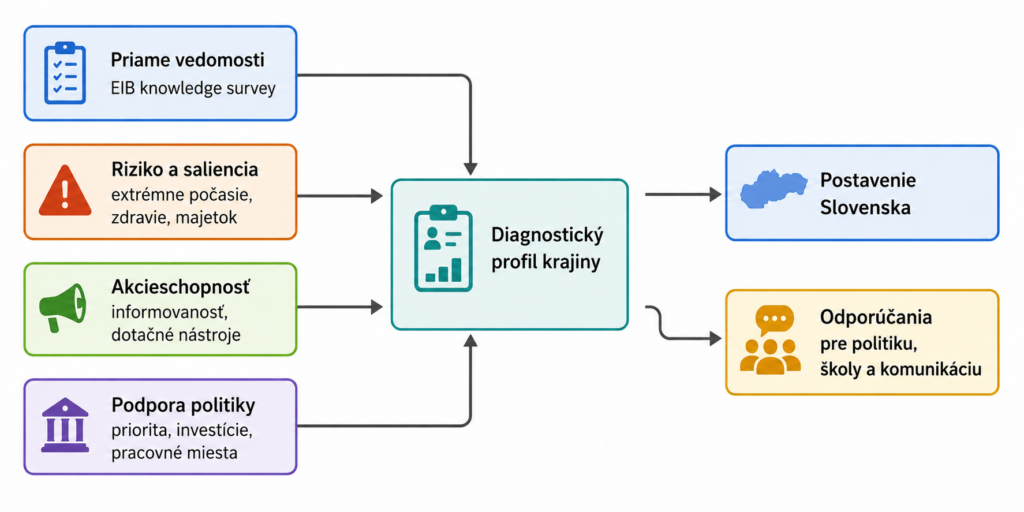
This report uses climate literacy as the ability to understand the causes, consequences and solutions of climate change and carbon literacy as the ability to link everyday decisions to greenhouse gas emissions and to act to reduce emissions. As the EU does not yet have one official, harmonised climate or carbon literacy index for all Member States, the report is working with proxy profile based on official comparable data: the EIB direct knowledge test, risk perception, experience with extreme weather, household action capacity and support for adaptation investments. This is in line with the EIB measuring knowledge with a separate test and the European Commission continuing to develop a broader approach to monitoring „learning for sustainability“.
Main conclusion: Slovakia is in the EU below average in direct knowledge and actionability, but above average in experienced climate exposure a slightly above average in support of investing in adaptation. In other words: Slovakia is not a "low-problem" country; on the contrary, it feels climate risks significantly, but the practical orientation on what exactly to do and what public tools are available is weaker.
In the EIB direct knowledge test, Slovakia achieved 6,16/10, the EU average was 6,37/10. Slovakia therefore belongs more to lower third to lower middle EU in a direct knowledge profile. At the same time, however, 87 % of respondents in Slovakia reported that they had been directly affected by at least one extreme weather event in the last five years, compared to 80 % in the EU; 63 % reported the impact of heat waves or heat waves, versus 55 % in the EU; and 23 % reported health problems due to extreme weather, compared to 20 % in the EU.
Slovakia is weaker especially in practical carbon literacy: only 29 % of respondents knew that better insulation of buildings helps mitigate climate change; only 13 % knew about the climate benefits of lower speed limits; and only 34 % knew about public subsidies or financial incentives to adapt households to rising temperatures, with the EU average 40 %. Only 66 % feel informed about what they can do personally, compared to the EU average 71 %.
This combination is politically important: Slovakia has lower adaptation priority than the EU (35 % vs. 50 % identifies adaptation as a priority), but at the same time above average supports investing today to avoid higher costs tomorrow (88 % vs. 85 %) and sees adaptation investments as an economic opportunity (87 % vs. 86 %). This suggests that a communicatively effective framework is not an „abstract climate“, but protecting health, housing, energy bills and the local economy.
Concepts and methodology
I use two operational definitions in this report. Climate literacy means that individuals understand what climate change is, what causes it, what its consequences are, and what policies or personal choices matter. Carbon literacy is narrower: it is the ability to understand one’s own carbon footprint, to recognise the emissions consequences of everyday choices in housing, transport, consumption and food, and to translate this understanding into behaviour. Given the absence of a single official pan-European index, it is therefore appropriate to assess countries through a combination of direct tests of knowledge and proxy indicators of actionability, risk perception and institutional support. This is the analytical framework of this report; its need is supported by the fact that the EIB measures knowledge with a separate test and the European Commission is still building a broader monitoring of learning for sustainability.
The core data is based on two official EIB surveys. Sixth edition of the EIB Climate Survey measures knowledge in three areas — definitions and causes, consequences, and solutions — using 12 questions and composes them into a score 0 to 10; covers more than 30,000 respondents in 35 countries, including the EU-27. Seventh edition of the EIB Climate Survey 2024 about the adaptation was implemented August 6 to 23, 2024, included 24 148 respondents, all 27 EU Member States and the USA; national samples were representative of the population 15+ and the typical sampling error for a sample of around 1,000 respondents is approximately ±3.1 pp., with a sample of around 500 approximately ±4.5 pp.
For political and educational use, I propose an indicator framework in five blocks: knowledge (overall score, causes, consequences, solutions, carbon footprint); risk and salience (extreme weather, health, property, adaptation priority); actionability (awareness, knowledge of subsidy instruments, ability to reduce carbon footprint); behavior and policy support (support for investments, perception of economic benefits, public acceptance of measures); and educational/institutional prerequisites (curriculum, teacher training, GreenComp, PISA, Eurostat, Eurobarometer). The European Commission already recommends that all learners have access to quality education on sustainability, climate and biodiversity, and the GreenComp framework distinguishes four areas of competence: values, complexity, imagining the future and action.
Results
Slovakia has in the EU mixed profile. On the axis "„knowledge and practical solutions“" is below average: overall score 6,16/10 vs. 6,37/10, causes 6,97/10 vs. 7,21/10, consequences 7,35/10 vs. 7,65/10 and solutions 4,16/10 vs. 4,25/10. On the axis "„risk and personal experience“" is above average: at least one extreme event 87 % vs. 80 %, heat 63 % vs. 55 %, thunderstorms/hail 45 % vs. 34 %, health problems 23 % vs. 20 %. On the axis "„actionability and information environment“" is below average again: awareness of what to do 66 % vs. 71 %, knowledge of subsidies 34 % vs. 40 %. On the axis "„pragmatic support for measures“"Slovakia is rather above average: adaptation creates jobs and supports the local economy according to 87 % respondents vs. 86 % in the EU, and 88 % agrees that it is necessary to invest today to avoid higher future costs, vs. 85 % in the EU.
The best scores in the EIB knowledge test were Finland (7.22), Luxembourg (7.19), Sweden (6.96), Portugal (6.90) a Croatia (6.78). At the opposite end were Cyprus (5.57), Romania (5.77), Malta (5.84), Poland (5.87) a Latvia (5.92). Slovakia with 6,16 falls below average and according to available values approximately within lower third to lower middle EU. I was unable to reliably verify the value for Ireland in the captured outputs, so I will continue to mark it as n/a.
The following comparison matrix synthesizes highly reliable official data from national websites EIB Climate Survey 2024 about knowledge and EIB Climate Survey 2024 – adaptation on risks, awareness and attitudes. Abbreviations: K = knowledge score 0–10; AP = adaptation is a priority; JOB = adaptation creates jobs/local economy; INV = you need to invest now; EXT = at least one extreme event in 5 years; HEAT = impact of heat; STORM = storm/hail impact; HP = health problems from extreme weather; CAR = fear of damage to house/car; INF = feels informed about what to do; AID = knows about public subsidies; COL = rising cost of living among top challenges.
| State | K | AP | JOB | INV | EXT | HEAT | STORM | HP | CAR | INF | AID | COL |
|---|---|---|---|---|---|---|---|---|---|---|---|---|
| AT | 6.49 | 37 | 79 | 79 | 73 | 49 | 38 | 15 | 48 | 82 | 41 | 56 |
| BE | 6.49 | 51 | 85 | 81 | 72 | 40 | 31 | 18 | 51 | 63 | 43 | 57 |
| BG | 6.10 | 50 | 88 | 89 | 94 | 62 | 41 | 23 | 69 | 71 | 45 | 53 |
| HR | 6.78 | 40 | 89 | 90 | 91 | 65 | 49 | 23 | 79 | 78 | 42 | 76 |
| CY | 5.57 | 64 | 96 | 93 | 99 | 49 | 30 | 26 | 92 | 86 | 79 | 39 |
| CZ | 6.12 | 30 | 82 | 83 | 81 | 51 | 38 | 23 | 44 | 62 | 40 | 56 |
| DE | 6.49 | 40 | 78 | 77 | 71 | 48 | 31 | 16 | 49 | 79 | 33 | 47 |
| DK | 6.76 | 68 | 88 | 88 | 65 | 25 | 28 | 12 | 42 | 69 | 37 | 40 |
| EE | 6.46 | 16 | 77 | 79 | 73 | 39 | 36 | 18 | 42 | 72 | 34 | 71 |
| EL | 6.39 | 60 | 92 | 90 | 94 | 61 | 32 | 24 | 86 | 72 | 68 | 64 |
| EC | 6.37 | 66 | 89 | 88 | 89 | 73 | 26 | 27 | 70 | 58 | 27 | 56 |
| FI | 7.22 | 23 | 82 | 83 | 61 | 34 | 19 | 12 | 25 | 70 | 38 | 62 |
| FR | 6.42 | 56 | 90 | 88 | 80 | 56 | 31 | 16 | 54 | 63 | 44 | 57 |
| HU | 6.06 | 46 | 87 | 86 | 90 | 67 | 45 | 30 | 70 | 70 | 43 | 61 |
| IE | n/a | 55 | 90 | 90 | 69 | 26 | 40 | 10 | 53 | 75 | 41 | 79 |
| IT | 6.41 | 67 | 91 | 91 | 89 | 61 | 37 | 23 | 76 | 75 | 49 | 46 |
| LT | 6.45 | 28 | 88 | 87 | 85 | 49 | 59 | 19 | 60 | 62 | 28 | 55 |
| LU | 7.19 | 47 | 83 | 82 | 79 | 47 | 42 | 14 | 40 | 74 | 47 | 71 |
| LV | 5.92 | 23 | 72 | 77 | 80 | 34 | 49 | 21 | 59 | 52 | 29 | 48 |
| MT | 5.84 | 77 | 97 | 97 | 97 | 53 | 28 | 29 | 87 | 91 | 82 | 41 |
| NL | 6.46 | 49 | 86 | 77 | 59 | 34 | 29 | 13 | 37 | 75 | 48 | 61 |
| PL | 5.87 | 25 | 83 | 77 | 83 | 56 | 47 | 17 | 50 | 70 | 40 | 53 |
| PT | 6.90 | 66 | 95 | 95 | 86 | 63 | 16 | 24 | 67 | 77 | 47 | 73 |
| RO | 5.77 | 59 | 92 | 90 | 93 | 71 | 44 | 29 | 70 | 81 | 39 | 72 |
| SE | 6.96 | 52 | 84 | 85 | 64 | 29 | 22 | 12 | 23 | 70 | 26 | 45 |
| SI | 6.44 | 43 | 85 | 89 | 89 | 46 | 62 | 17 | 68 | 78 | 52 | 61 |
| EN | 6.16 | 35 | 87 | 88 | 87 | 63 | 45 | 23 | 57 | 66 | 34 | 63 |
According to this matrix, Slovakia is a country in the EU with higher than average exposure a below average practical readiness. If we focus on carbon literacy in the narrow sense, Slovakia lags behind especially in areas with high political relevance and direct impact on households: building insulation, energy efficiency, transport choices, and orientation in available support.
The following profile summarises Slovakia against the EU average on an extended set of indicators. The source is the same official EIB outputs; the first three knowledge sub-indexes are directly from the Slovak national page of the sixth edition.
| Indicator | Slovakia | EU average |
|---|---|---|
| Total knowledge score 0–10 | 6.16 | 6.37 |
| Cause subindex 0–10 | 6.97 | 7.21 |
| Subindex consequences 0–10 | 7.35 | 7.65 |
| Solution subindex 0–10 | 4.16 | 4.25 |
| Correct definition of climate change % | 69 | 71 |
| Recognition of human causes % | 70 | 74 |
| Correct identification of US/China/India as top % issuers | 71 | 72 |
| Adaptation is a priority for % | 35 | 50 |
| Adaptation creates jobs/local economy % | 87 | 86 |
| You need to invest today % | 88 | 85 |
| At least one extreme event in 5 years % | 87 | 80 |
| Impact of heat % | 63 | 55 |
| Storm/hail impact % | 45 | 34 |
| Health problems from extreme weather % | 23 | 20 |
| Fear of damage to house/car % | 57 | 58 |
| Feels informed about what to do % | 66 | 71 |
| Knows public subsidies/tools % | 34 | 40 |
| Rising cost of living among top challenges % | 63 | 55 |
Slovakia's strength is not abstract "climate enthusiasm", but rather pragmatic openness to protective investments, when linked to damage prevention and economic benefits. Support for the statement that it is necessary to invest today to avoid higher costs tomorrow is high in Slovakia, as is the belief that adaptation infrastructure can support the local economy and jobs. This is crucial for public policy: in Slovakia, it is probably more effective to frame climate measures as protection against damage and saving future costs, not as a moral abstraction.
The weak point is actionability based on knowledge of solutions. Slovak respondents understand climate significantly more than the immediate weather and less than concrete solutions. The knowledge gap is largest in measures that are key to decarbonizing households in the EU: building renovation, transportation habits and other everyday decisions. Moreover, only a third of respondents know about the available public support tools. This is the core of the problem of carbon literacy in Slovakia: not the absence of any awareness about climate, but weaker translation of knowledge into concrete household decision-making.
The difference between Slovakia and parts of northwestern Europe is explained by at least three factors. First, higher exposure: According to the EIB, Slovakia is among the countries where respondents more often report the impacts of extreme weather, especially heat waves and storms. Secondly, cost of living agenda: in Slovakia, price increases are a more prominent top topic than in the EU average, which may reduce political and media space for climate issues as a separate priority. Third, weaker information architecture for households, which is seen in lower awareness and poorer knowledge of supports. The second and third factors are inferences from survey data, not directly measured causal effects.
From a European perspective, a spatial pattern is also clear: Southern and Eastern Europe shows higher reported exposure, more frequent health consequences and greater concern for property, while northern Europe has generally lower reported exposure and at the same time a better knowledge score. Slovakia is in this sense a „hybrid“: in terms of impacts it is closer to the more exposed south and east, but in terms of knowledge it does not match the north and the best western performers.
Slovakia should do three things in the short term. First, introduce a unified, "one-stop-shop" communication layer for households: a simple explanation of what climate change means for heating, housing, health and insurance claims, plus where and how to get support for insulation, shading, passive cooling and energy savings. The data shows that this is where the gap between risk and action lies. Second, target communication at practical carbon choices: buildings, heating, transport, consumption. Third, consistently connect the topic with cost of living and household resilience, because this framework is the most politically resonant in Slovakia.
In education, Slovakia should move from one-off projects to curricular mainstreaming. The European Commission already recommends that all learners have access to quality sustainability and climate education, and GreenComp provides a practical framework of four competence areas. For Slovakia, this means: embedding climate and carbon literacy in primary and secondary education, linking it to STEM, civics, geography and vocational education, while systematically preparing teachers. Without teacher support, the gap between „knowing about climate“ and „knowing how to act“ will not be reduced.
In the medium term, I recommend creating National Climate and Carbon Literacy Panel, repeated at least once a year and methodologically linked to the EIB, Eurobarometer and OECD/PISA. The state would thus obtain hard data on which population groups do not understand the solutions, where the problem lies in information and where in the real ability to act. This panel should also include indicators for schools and teachers, so that it is possible to link public opinion, education and household results. The OECD already has a PISA 2022 database and the European Commission is building a learning for sustainability monitoring; Slovakia should methodologically connect to these frameworks.
In the long term, it is appropriate to combine climate and carbon literacy with energy literacy and local participation. This means expanding advisory services for households, municipalities and schools; involving local governments in local adaptation plans; and creating participatory forums in which climate action is explained through local floods, heat waves, insurance, schools and public spaces. According to the EIB’s findings, Slovakia has a relatively good basis for accepting investments in adaptation; it lacks in particular a permanent infrastructure for explanation and everyday decision-making.
Open questions and main sources
This version is rigorous policy brief, not a full technical annex. Two limitations are important. First, I was unable to reliably verify in the captured official outputs Irish overall knowledge score, therefore it is marked as n/a. Second, I use diagnostic profile, not a single aggregate composite index, because to create a fully harmonised 15+ indicator index it would be necessary to add Eurobarometer country tables, OECD/PISA, Eurostat and more detailed curriculum data from Eurydice and national ministries. The European Commission itself states that monitoring learning for sustainability is being developed, and the OECD holds the PISA 2022 database as a primary source for further expanding the analysis.
How the most relevant academic and political references For another technical annex I recommend:
- EIB Climate Survey 2024 — knowledge edition and national sites of EU countries that provide a direct knowledge test 0–10 and its sub-indices.
- EIB Climate Survey 2024 — adaptation report, which offers pan-European country rankings for risk perception, experience with extreme weather, awareness and policy support.
- European Education Area — Learning for the green transition and sustainable development, including Council Recommendation 2022 and GreenComp.
- OECD PISA 2022 Results a PISA 2022 Database as a primary source for the school knowledge component and expansion of the annex to include educational proxy indicators.
- Eurobarometer — Climate change survey page as a preferred supplementary source for further replication and supplementation of communication and attitudinal indicators.
One-sentence conclusion: Slovakia is not among the countries with the weakest climate sensitivity in the EU — on the contrary, it feels climate risks strongly — but it lags behind in transforming these experiences into widespread, practical carbon literacy and everyday actionability. JRi&CO2AI

