 EN
EN  SK
SK 

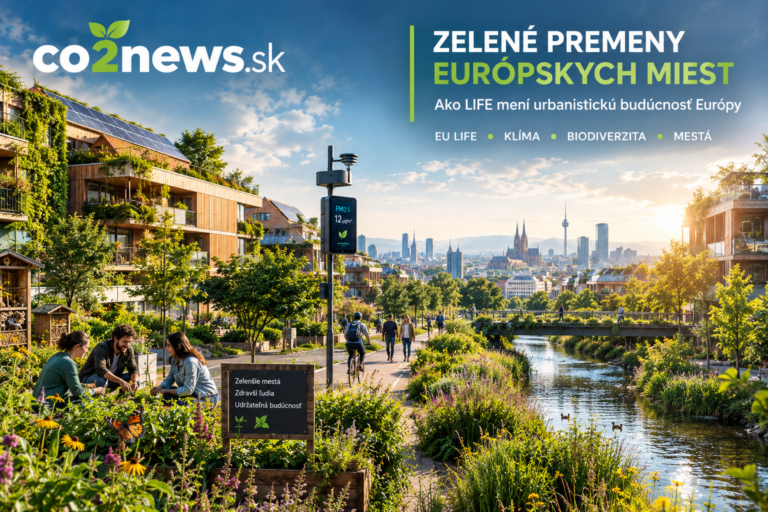
From green roofs and wooden buildings to active citizen engagement, nine innovative projects show the way to sustainable, climate-neutral and resilient cities. Modern European cities are at the heart of the green and climate transformation. They are the urban environment where the consequences of climate change are fully manifested, but at the same time they represent a space for the application of the most innovative solutions. The key financial instrument of the European Union to support environmental and climate objectives is LIFE programme. Publication The European Executive Agency for Climate, Infrastructure and Environment (CINEA) presents nine successful projects that demonstrate how cities in Europe are transforming into greener, healthier, more inclusive and resilient environments to live in. This transformation is taking place along three main dimensions: urban renewal, sustainable construction and citizen participation in governance.
Green Cities: Bringing Nature and Biodiversity Back to the Urban Landscape
Nature-based solutions (Nature-based Solutions) and urban regeneration represent a fundamental building block of protection against climate risks.
Project LIFE BauhausingEurope shows how public buildings can be a catalyst for the renewal of entire neighborhoods according to the principles of the New European Bauhaus (NEB). It operates in five municipalities in Spain, Hungary, Latvia and Croatia (Budapest, Cartagena, Blanca, Varaždin and Ādaži). The project is implementing a sustainable renovation of five public buildings, achieving energy savings of up to 46 %. The project integrates rainwater harvesting, material reuse and the establishment of community fruit forests. In Budapest, the historic Bethlen Theater is being transformed, in Varaždin, the former military complex Beli kipi and in Blanca, an old fruit warehouse is being transformed into a youth and community center.
The project directly focuses on restoring urban biodiversity LIFE SeedNEB. In three pilot cities – Lorquí (Spain), Potenza (Italy) and Dunaújváros (Hungary) – it integrates natural elements into schools, public buildings and courtyards. Three biodiversity offices and three Bauhaus Citizen Schools have been set up, involving over 800 participants. The created habitats support pollinators and birds, while in Dunaújváros the city arboretum is being revitalized.
The solution to the problem of urban heat islands is brought by the project BIG4LIFE, which focuses on green roofs and facades. It verifies the management and maintenance of greenery in Mediterranean conditions at nine demonstration sites in the Spanish cities of Barcelona and Lleida. Thanks to intelligent irrigation management, it can reduce water consumption by up to 80 %. In addition to monitoring 30 species of birds on green roofs, these green areas serve as open classrooms for schools or relaxation areas for residents.
Sustainable construction and circular materials
The transition to climate-neutral cities requires a fundamental change in the construction sector, which must reduce its carbon footprint and increase resource efficiency.
Project LIFE BE-WoodEN promotes the use of wood and bio-materials in urban construction. In the Italian city of Imperia, a participatory renovation of common spaces in social housing for seniors using wooden structures was carried out, involving 55 volunteers. In the Emilia-Romagna region, the project developed a roadmap for the local wood supply chain and reached over 30,000 professionals and citizens with educational activities.
The enormous potential of bio-insulation materials in the renovation of historic buildings and social housing is demonstrated LIFE BIOMATINE in Amsterdam. The project renovates more than 500 apartments in the Tasman Blocks complex and the roof structure of the listed Centrale Markthal. The use of renewable bio-materials instead of fossil insulation will save 350 tons of CO₂ emissions, with annual energy savings in social housing of 1.08 GWh (200 tons CO₂eq). In addition, an accredited bio-academy trains 93 construction contractors and practitioners.
Project brings innovative solutions beyond EU borders LIFE HEAT, operating in the city of Nizhyn, Ukraine. The project is implementing a deep renovation of a three-story brick apartment building from 1936 with 20 apartments. Using prefabricated facade and roof panels, digital design tools, and circular materials, it creates a model of sustainable and affordable renovation for the aging housing stock in Ukraine.
A broader framework for life cycle assessment of buildings is provided by the project More LIFE to LEVEL(s). This project tests a common European framework Level(s) on 11 buildings in six countries (Germany, Spain, Denmark, Austria, Hungary and Italy). Using examples such as the renovation of the historic Heeresbäckerei bakery in Kassel or the biocircular IMPSOL social housing house in Sant Boi de Llobregat, they show how to assess the carbon footprint and circularity throughout the entire life cycle of buildings.
Citizen engagement and integrated urban governance
The green transition cannot be just a technological change – it requires active community engagement, behavioral change, and transparent governance.
An exemplary model of integrated governance is the project LIFE HELP in Rimini, Italy. The project established a permanent committee, the „Environment Hub“, in which city representatives jointly coordinate environmental objectives. It created the WA2NNA-BEST evaluation index and digital bulletin boards to translate more complex data into a comprehensible form for the public. Four noise sensors and two weather stations with real-time data transmission were installed on the Parco del Mare promenade. Thanks to the project, Rimini adopted 34 environmental objectives, obtained ISO 14001 certification, EMAS registration, signed a commitment Green City Accord and trained over 1,000 local government employees. The Youth City Council was also involved in the decision-making.
It also focuses on building a governance ecosystem LIFE GreenMe5, which connects five cities in Europe (Cieza and Murcia in Spain, Arezzo in Italy, Vilnius in Lithuania and Helsingborg in Sweden). The project involved more than 280 actors. In Murcia, food waste audits were carried out with 978 pupils from six primary schools, in Ciez children co-designed a schoolyard, in Vilnius traffic management for cleaner air was tested and in Helsingborg an urban waterway was restored.
Investing in a green future for European cities
The examples from nine LIFE projects clearly show that successful urban transformation requires a combination of elements: urban green development, innovative architecture, circular building materials, sustainable governance and an engaged community. As EU Environment Commissioner Jessika Roswall stressed during her visit to the New European Bauhaus Festival, investing in green infrastructure means investing in public health, biodiversity and a better life in cities. Thanks to EU support programmes, European cities are becoming better prepared for the climate challenges of the future. JRi&CO2AI
Co2AI can make mistakes. Check important information.

