 EN
 SK


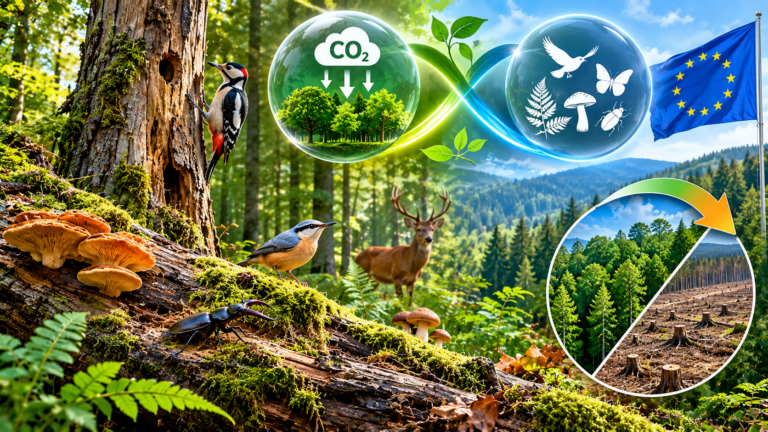
🌲 Climate change and massive loss of species diversity are among the most significant environmental challenges of our time. Forest ecosystems play a key role in solving both of these problems – they serve as a significant carbon sink and provide refuge for thousands of species organisms. European environmental policy has long assumed that measures to increase carbon storage will automatically benefit nature conservation. The latest large-scale research published in the journal Nature Communications (Balducci et al., 2026) shows, however, that this assumption is simplistic and the potential for mutually beneficial synergies (so-called win-win effects) between carbon storage and biodiversity protection in European forests is significantly limited.
Research scope and methodological approach
The study authors aimed to assess the relationships between aboveground carbon stocks and species richness of six key taxa across Europe. They used the European database from the Bottoms-Up platform, which brings together harmonised field data from 12 European countries. The research sample included 7,971 research sites, 3,520 species and more than 140,000 field observations.
The following groups of organisms were analyzed in the study:
- vascular plants,
- epiphytic and epixylic bryophytes,
- epiphytic and epixylic lichens,
- wood-decaying fungi,
- saproxylic beetles,
- birds.
The assessment focused on three distinct above-ground carbon pools: living standing trees (living biomass), standing dead wood (dead standing trees and trunks) and lying dead wood (fallen trunks and branches). Advanced statistical models based on decision trees (Boosted Regression Trees – BRT) were used to evaluate the relationships.
Living biomass is not a universal indicator of biodiversity
Between 1990 and 2020, the carbon stock in the living biomass of European forests increased from 8 to almost 12 billion tonnes. Although around 30 % of forest area in Europe is classified as habitats with conservation value, up to 80 % forest habitat assessments show an unfavorable conservation status.
The study confirmed that carbon accumulation in the living biomass of standing trees is not a reliable proxy for overall forest biodiversity. The relationship between living biomass and species richness for most taxa was weak or neutral. The exception was wood-destroying fungi, which responded positively to the increase in living biomass. In contrast, in vascular plants, when the stock of living biomass increased above approximately 1 t C/ha, a significant decrease in species richness. This decline is mainly due to reduced light availability on the forest floor beneath the dense, connected canopy.
In commercial forests, high stocks of living biomass are often achieved by growing even-aged, homogeneous stands of fast-growing woody species. While these stands sequester significant amounts of carbon, they lack the structural diversity and ecological continuity required by many specialist species.
The key role of dead wood for forest diversity
Unlike living biomass, carbon stocks in dead wood have been shown to be a crucial factor in maintaining the species richness of several groups of organisms. Dead wood accounts for approximately 7 % of the total wood stocks in Europe and plays an irreplaceable role in nutrient cycling and food webs.
- Lying dead wood: Analyses showed a very strong positive effect of lying dead wood on the species richness of wood-destroying fungi and lichens. The species richness of fungi increased sharply even at low lying wood stocks (from 0.03 t C/ha). Lichens required higher stocks (from 0.1 t C/ha), which is related to the need for specific light conditions in the gaps in the stands.
- Standing dead wood: Standing dead wood had the most significant positive effect on saproxylic beetles and wood-decaying fungi (the increase in species richness started from 0.1 t C/ha). The higher benefit of standing dead wood for beetles is mainly related to the larger size of dead trunks, which provide a stable substrate for the development of their larvae.
In addition to carbon stocks, environmental and management factors, especially altitude and the cultivation system used, also had a significant impact on species richness.
Implications for European forestry policy and practice
The study's findings are of fundamental importance for the reassessment of European and global climate policies. Current initiatives and legislative frameworks (such as REDD+, regulation LULUCF or the EU Forest Strategy by 2030 to plant 3 billion trees) are predominantly focused on increasing carbon stocks in living above-ground biomass. However, if in practice the accumulation of living biomass is exclusively prioritised, this can lead to the homogenisation of stands and the suppression of light-dependent and deadwood species.
Another risk is the growing demand for woody biomass as a substitute for fossil fuels. In 2022, approximately 24 % of EU log harvest used as fuelwood. Increased removal of logging residues from forest ecosystems reduces deadwood stocks and directly threatens endangered saproxylic species.
The path to integrated management
The authors of the study emphasize that policy frameworks and national forest inventories must stop viewing living biomass as a universal proxy for biodiversity. To achieve sustainable management, it is necessary to move towards close-to-nature forest management (closer-to-nature forest managementThis approach combines the maintenance of a stock of living biomass with the active retention of standing and lying dead wood, ensuring long-term carbon storage and the protection of the complex diversity of European forests. JRi&CO2AI

