 EN
 SK


Adoption of the Kunming-Montreal Global Biodiversity Framework (KMGBF) at the COP15 conference, it represents for the Member States of the European Union – which, together with the EU as a separate entity, are Parties to the Convention on Biological Diversity (CBD) – a key commitment to halting and reversing the loss of natural resources by 2050. Unlike previous strategic plans, the KMGBF explicitly emphasizes the need a "whole of government and whole of society" approach„. Successful implementation of the 23 global goals at national level through updated National Strategies and Action Plans (NBSAPs) requires close linkages between decision-makers and knowledge providers. However, analysis of persistent scientific and capacity gaps shows that academic publications alone are not enough. For research in EU Member States to have a real impact on legislation and policy decisions, it is crucial systematic training of researchers in knowledge brokering and their involvement in cohesive academic networks.
Academic institutions in the EU as providers and brokers of knowledge
The analysis of national NBSAP strategies confirms that governments perceive academic and research institutions as one of the most important partners in the implementation of biodiversity policies. The results of the network analyses show that universities play a dual and irreplaceable role in national networks:
- Knowledge providers: They achieve high degree centrality, which reflects their direct ability to deliver expert data and scientific research.
- Knowledge brokers: They exhibit high betweenness centrality, closeness centrality, and eigenvector centrality.
In the context of EU Member States, this means that academic institutions act as information bridges, which can connect different government departments (e.g. environment, agriculture, finance or regional development) with NGOs, the private sector and local communities. Academics can also identify and connect synergies between multiple KMGBF goals at the same time – for example, linking pollution reduction with the protection of endangered species and the restoration of ecosystems. However, this huge intermediary potential often encounters obstacles, such as academic evaluation metrics based almost exclusively on the number of publications.
Synergy between European TSCCs and cohesive academic consortia
To support Parties in meeting their commitments, the CBD has adopted a mechanism of 18 regional technical and scientific cooperation centres (TSCCs), five of which operate in Europe. The study shows that TSCCs play a particularly important role organizational and supervisory role – they function as „one-stop shops“, creating cohesive subgroups of actors and facilitating communication with the CBD Secretariat.
However, TSCCs alone cannot automatically increase direct proximity between disconnected actors at the local level or cover the full breadth of specific scientific topics. This is where the complementary role of cohesive academic networks and consortia, such as the European platform Eclipse (aimed at linking research with European biodiversity policy), British consortium CASCADE whether the network UPEN. When universities come together in a coordinated consortium, they create flexible new network connections, connecting previously isolated actors and promoting collaborative learning without disrupting the organisational structure of the TSCCs. For EU Member States, this implies the need to support national and transnational academic networks that act as a unified and coordinated partner for public authorities.
Moving from publications to five knowledge exchange tasks
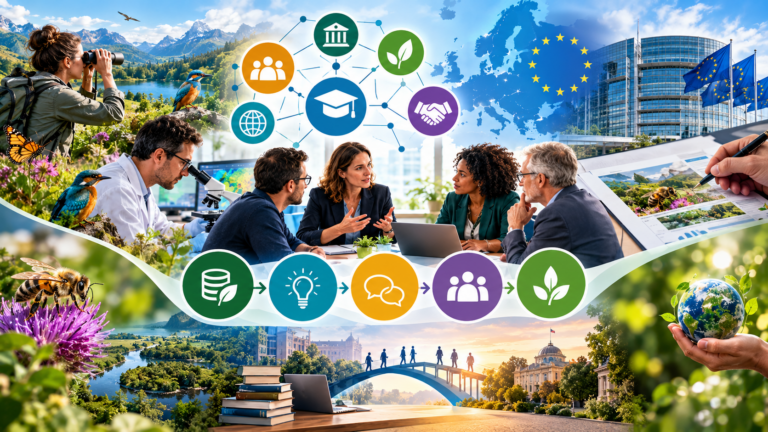
The traditional academic approach focuses on the production of scientific studies, which only corresponds to the first two phases of knowledge exchange. However, according to the model of Tengö et al. (2017), effective collaboration between different knowledge systems includes five key tasks:
- Knowledge mobilization (data collection and generation),
- Synthesis (summarization and evaluation of knowledge),
- Translation (adapting complex ecological findings to the language and needs of policymakers),
- Negotiation (simultaneous search for agreement between scientific, political and local knowledge systems),
- Application (direct implementation and use of knowledge in practice).
For EU research to have a real impact on policy cycles, training for researchers needs to move from mere mobilization and synthesis to translation, negotiation and application. Researchers need to learn to prepare two-page policy briefs for decision-makers, lead transdisciplinary workshops and participate in policy co-production.
Building capacity for credible, legitimate and relevant research
In order for scientific evidence to be accepted and used in the decision-making processes of EU Member States, it must meet three basic criteria, according to Cash et al. (2003):
- Credibility: Scientific and methodological soundness of the findings.
- Legitimacy: Respecting diverse knowledge systems, equitable partnerships and socio-economic contexts.
- Relevance: A direct response to legislators' pressing, time-sensitive needs and questions.
Targeted knowledge brokering training teaches European researchers to understand policy cycles, communicate without jargon and practice boundary management. It also helps to eliminate parachute science and build sustainable, equal partnerships in international research collaboration.
For the Member States of the European Union, meeting the objectives of the Kunming-Montreal Global Framework is not only a legal and environmental obligation, but also an opportunity to modernize the relationship between science and policy. Investments in systematic training of researchers in knowledge transfer and building coherent academic consortia will ensure that scientific knowledge from European universities does not remain locked in journals, but serves as a credible, legitimate and relevant basis for biodiversity protection. JRi&CO2AI

