 EN
 SK


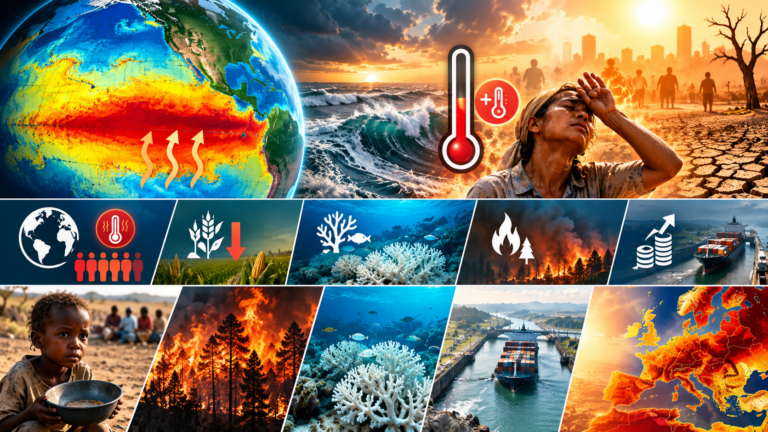
Climate models around the world are sending out an unprecedented warning: the planet is facing one of the most intense and destructive El Niño events in modern history. The latest projections show that warming in the Pacific Ocean in In the key region, Niño 3.4 is reaching extraordinary anomalies and is estimated to be approaching the threshold of +3.5°C above the long-term average. Weekly measurements of surface water temperatures jumped to +3.3°C in the autumn and have remained above three degrees for five consecutive weeks, with anomalies exceeding +4.0°C in parts of the eastern Pacific Ocean and subsurface temperatures at depth showing deviations of more than +10°C. The heat content in the upper 300 meters of the ocean has even surpassed the level of the Super El Niño of 1997-1998. With a probability exceeding 83 %, this phenomenon will persist as extremely strong until early 2027, with the most extreme simulations predicting anomalies exceeding +4°C.
Hundreds of thousands of deaths due to extreme heat
The most frightening consequence of this climate shift is the massive human toll. Analysis by the Climate Impact Lab projects that this „Super El Niño“ will cause more than 451,000 deaths The consequences of extreme heat. This tragedy will primarily affect countries in the Global South, where poverty and lack of access to cooling make it impossible to survive in intolerable temperatures.
In the African Sahel region alone, over 66,800 additional deaths are estimated, including over 31,400 in Nigeria, 17,500 in Sudan, 10,000 in Niger and 8,000 in Chad. In Southeast Asia, extreme heat will claim over 19,400 lives in the Philippines, Vietnam, Thailand and Cambodia, and another 19,300 in Indonesia. India is projected to lose 15,800 lives and Brazil 13,300. As Professor Michael Greenstone points out, behind these huge numbers are the real people – parents, children and neighbours – who are paying the price for the global failure to adapt.
Food crisis, fires and ecosystem collapse
The devastating effects of El Niño are compounding ongoing global climate change, dramatically worsening the state of natural resources. The European Joint Research Centre (JRC) warns of a global rise in food prices, particularly for durum wheat and maize. This pressure comes at a time when agrarian systems are already weakened by conflict and fuel and fertiliser shortages. In the oceans, marine heatwaves are destroying seagrass, coral reefs and destabilising fisheries, including the Peruvian anchovy.
Large areas of Central America, the Caribbean, southern Africa, Indonesia and Australia are facing drastic drought and water shortages. Dry and hot conditions create an ideal environment for uncontrolled forest fires. In the Brazilian Amazon, where fires in previous strong years have burned more than 2.3 million hectares of forest, the most significant wave of devastation is expected in the second half of 2027. Freshwater ecosystems are also affected: warming lakes extend the period of water stratification, deplete oxygen in deeper layers and promote the formation of toxic cyanobacteria.
A shock for the global economy and Europe
The ecological devastation is quickly spilling over into the economic sphere. Danske Bank’s analysis highlights that physical climate risks will spill over into global supply chains through four main channels: operational disruptions, supply chain disruptions, cost pressures and demand shifts. The decline in water levels in key shipping lanes such as the Panama Canal, combined with disruptions in agriculture and energy, will create huge losses for industry and investors alike.
Europe will not be left out either. JRC reports show that above-average warm conditions will hit the European continent in the autumn and their intensity will increase in the spring of 2027. Meanwhile, global land temperatures are heading towards a limit of up to +2.7°C. This „Super El Niño“ is a chilling reminder that the climate crisis is no longer a distant threat, but an imminent threat to human lives and the stability of the world.
JRi&CO2AI
Co2AI can make mistakes. Check important information.

