 EN
 SK


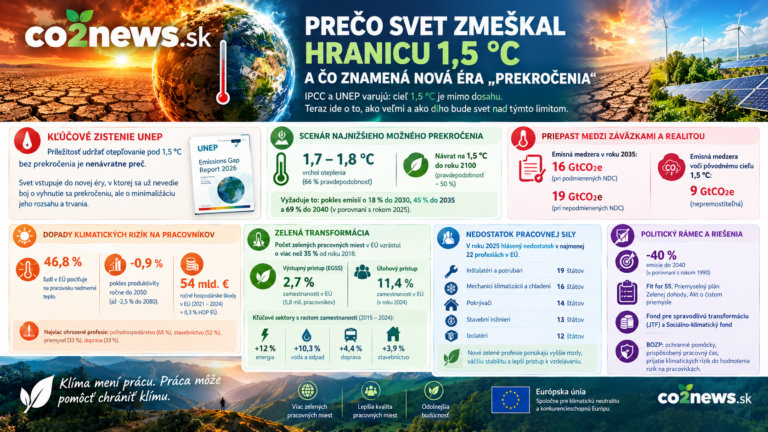
Seventeenth report UNEP on the emissions gap (Emissions Gap Report 2026) brings a chilling balance sheet: the opportunity to keep global warming below 1.5°C without exceeding it or with only a minimal overshoot is irretrievably gone. Decades Political procrastination and lack of climate action have led humanity to a new reality in which a temporary crossing of the critical temperature threshold has become inevitable. The climate is now at a crossroads where the fight is not to avoid the crossing, but to minimize its extent and duration.
New Reality: Lowest Possible Exceedance Scenario
The international community's response to the failure of current policies is to redefine the assessment against the scenario „"lowest possible 1.5°C overshoot". This scenario assumes that strict emissions controls start immediately from 2025, limiting the peak of warming to 1.7 to 1.8°C (with a 66 % probability) and by 2100 returns global temperature to or below 1.5°C with a probability of approximately 50 %.
But moving to this trajectory requires radical changes. Global greenhouse gas emissions must fall from 2025 levels by 18 % by 2030, by 45 % by 2035 and by 69 % by 2040. Between 2025 and 2035, this represents an average annual rate of decline of 5,7 %, with net CO2 emissions to reach zero around 2050.
The gap between commitments and mathematics
But what are the realistic promises of countries? Full implementation of the new nationally determined contributions (NDCs) will reduce emissions by only 5 to 8 % and by 2035 by 11 to 15 % compared to 2025. The result is abysmal emissions gap in 2035 at 16 GtCO2e under conditional NDCs (and 19 GtCO2e under unconditional ones) against the lowest exceedance scenario. Against the original 1.5°C target with minimal exceedance, there has already been unbridgeable gap 9 GtCO2e.
In 2025, global greenhouse gas emissions reached 58.4 GtCO2e. Although there was a slight decrease of 0.1 GtCO2e due to lower emissions from land use and forestry (LULUCF), emissions from fossil fuel combustion continued to grow. It is therefore not possible to speak of peaking emissions.
Geopolitical failures and unsustainable subsidies
A critical look at the geopolitical situation reveals deep divisions. The G20 countries produced up to 76 % global emissions (excluding LULUCF) and their emissions increased by 0.7 % year-on-year. Although 63 countries reduced emissions over the past decade (by a total of -1.8 GtCO2e), 124 countries increased them (by a total of +7.2 GtCO2e).
Global efforts have been particularly negatively impacted formal withdrawal of the United States from the Paris Agreement, thereby cancelling their national target and replacing their emissions in the models with the business-as-usual scenario. This step alone increased the emission projections under the NDC scenarios by 1.5 GtCO2e and contributed to an increase in expected warming of around 0.2°C.
Equally alarming is the financing paradox. While governments declare commitments to a clean energy transition, fossil fuel subsidies increased from $660 billion in 2018 to $920 billion in 2024.
Sector paradox: Green boom versus coal and forestry inertia
The energy transformation shows two faces. On the one hand, we are experiencing an unprecedented boom in renewable sources: the development of solar photovoltaics has grown to 7 times faster and wind energy 2.5 times faster, than predicted in 2015. In 2025, electricity generation from renewable sources will exceed 100% for the first time in history (33.8 %; 10,730 TWh) surpassed coal-fired electricity (33.0 %; 10,476 TWh). The electrification of transport is also progressing rapidly, with electric vehicle sales reaching 25% of passenger car sales.
On the other hand, total energy supplies from coal, oil and gas are still at historic highs. Efforts to halt deforestation are also lagging far behind – to reach the goal of zero deforestation by 2030, the rate of decline in forest loss must accelerate more than tenfold.
Where are we headed? 2.8°C warming on the horizon
If current policies continue without further tightening, the world is headed for warming by 2.8°C by 2100 (with a 66 % probability). If all unconditional and conditional NDCs are fully implemented, warming will be reduced to only 2.6°C. Even in the most optimistic scenario, which assumed the fulfillment of all NDCs and net zero commitments, warming will reach 2.1°C.
The UNEP report clearly highlights that „The "point of no return" begins right now. Every five years of emissions at current levels increases the peak temperature by about 0.1 °C and extends the period of dangerous exceedances. At the upcoming COP 31 climate summit and during the second global stocktake (GST), countries must not only increase the ambition of their national targets, but above all ensure their immediate, deep and sustained implementation, combined with massive removal of CO2 from the atmosphere. JRi&CO2AI

