 EN
EN  SK
SK 

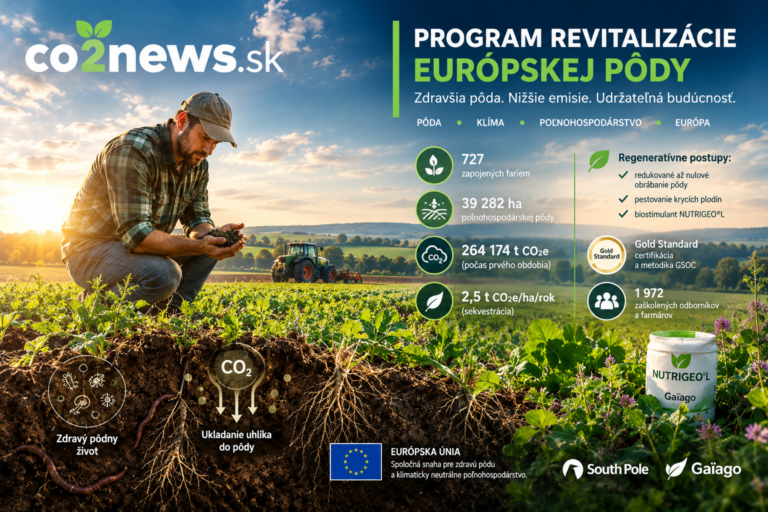
Soil is the second largest carbon sink on our planet, yet in Europe today, 60 to 70 % of soil is in an unhealthy and degraded state. Long-term use of conventional agricultural practices has significantly contributed to the depletion of agricultural land, the reduction of organic carbon content and the release of CO₂ emissions into the atmosphere.
European agriculture faces structural challenges
Today's agricultural sector in Europe faces serious structural problems. Cereal yields on the European continent have been stagnant for more than 20 years, which indicates the limits of the current economic model. At the same time, the agricultural sector contributes significantly to the production of greenhouse gases, as it is 23 % total emissions. Of this volume, up to 57 % emissions directly linked to ruminant farming and the use of synthetic nitrogen fertilizers.
The solution to these accumulated problems is to shift to regenerative and agroecological practices that have the potential to restore damaged ecosystems. However, implementing such changes poses a significant financial and operational burden for farmers themselves. Uncertainty about short-term impacts on productivity creates financial risk, which is a major barrier to the wider adoption of more sustainable methods in practice.
Comprehensive solution: European Soil Revitalisation Programme
To address these challenges, European Soil Revitalization Programme (European soil revitalization program), developed by the company South Pole. This programme provides systematic support to farmers across Europe in implementing regenerative agricultural practices that are designed to restore soil health and improve the resilience of the entire ecosystem.
The initiative promotes a comprehensive set of proven agronomic approaches:
- Reduced to zero tillage: It limits mechanical disturbance of the soil profile, thereby improving its structural stability and protecting soil life.
- Cover cropping: It ensures protection of the soil surface, increases water retention capacity and naturally strengthens nutrient content.
- Mandatory application of the biostimulant NUTRIGEO®L: Biostimulant produced by a French company Gaiago It promotes plant growth by improving the physicochemical characteristics of the soil and enhancing microbial diversity.
The program is officially certified under the standard Gold Standard and follows the methodology Soil Organic Carbon (SOC) Framework Methodology, specifically the activity module for biostimulants intended for soil revitalization. The program is currently being implemented in practice in France and Belgium by Gaïago.
Measurable environmental impacts and carbon storage
The practical application of regenerative practices within the program delivers direct environmental results by increasing soil organic carbon (SOC) stocks. Improving soil structure, fertility, and overall soil health helps to safely store carbon in the soil, while simultaneously strengthening and stabilizing yields in agricultural systems.
The climatic and spatial scope of the entire program reaches significant parameters:
- Scope of connection: Once all 727 participating farms are fully involved, the initiative will expand to an area exceeding 39,282 hectares agricultural land.
- CO₂ absorption: During the first crediting period, it is expected to remove and store up to 264,174 tons of CO₂e.
- Annual effect: In terms of calculation, this is a sequestration of approximately 2.5 tons of CO₂e per hectare per year.
The framework of the entire project meets the strictest international methodological requirements. It uses the protocol GSOC MRV from the Food and Agriculture Organization (FAO) and is fully aligned with the global initiative RECSOIL under the auspices of FAO.
Educating and empowering farming communities
In addition to the direct ecological and climate benefits, the programme plays an important role in the socio-economic field and in rural development. Changing the approach to land management requires the dissemination of expert knowledge and a change in established agrotechnical habits.
The program therefore actively strengthens local farming communities through a specialized educational program. So far, 1,000 people have been trained in a specially developed curriculum focused on soil revitalization and agronomy. 1,972 stakeholders and practitioners. This systematic education helps farmers overcome the initial concerns and risks associated with the transition to a regenerative model and ensures the long-term sustainability of the results achieved.
A model for the future of the European agricultural sector
European Soil Revitalization Programme shows that by combining sustainable agronomic practices, innovative biostimulants and certified market mechanisms, it is possible to achieve measurable soil restoration while supporting farmers themselves. This approach not only contributes to reducing emissions by sequestering carbon in the soil, but also protects the fertility of European soils and increases the resilience of the agricultural sector for future generations. JRi&CO2AI

