 EN
EN  SK
SK 

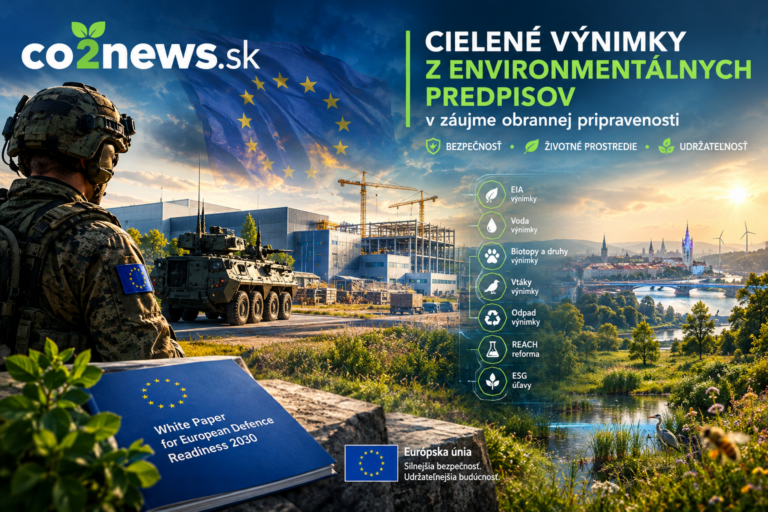
Following the Russian invasion of Ukraine in 2022, the Member States of the European Union became fully aware of the urgent need to strengthen their defence capabilities and guarantee European security. This strategic shift culminated in the presentation of White Paper on European Defence – Preparedness 2030 in March 2025, which set framework for the Preparedness 2030 plan (originally presented as the ReArm Europe plan) with the aim of mobilising around €800 billion in defence investment. However, the massive build-up of defence capabilities has come up against strict EU environmental and regulatory requirements. In response to this challenge, the European Commission presented a proposal in June 2025 Defense Readiness Omnibus. This legislative package introduces targeted exemptions from environmental legislation and simplifies approval processes, thereby seeking to balance urgent security needs with long-term environmental policy objectives. The Council of the EU and the European Parliament reached a provisional agreement on the Defence Preparedness Omnibus on 10 June 2026 and the European Parliament approved it on 16 September 2026.
Expedited permitting and defense as an overriding public interest
A key pillar of the new legislative measures is the dramatic acceleration of approval procedures for defence industry projects and related infrastructure. Both the White Paper and the Defence Readiness Omnibus explicitly identify the need to enable the rapid granting of construction and environmental permits as a priority of public interest. The rules introduced centralise approval processes and introduce an accelerated permitting system for so-called. defense readiness projects. These projects are defined as a set of activities, investments and measures aimed at increasing the defence preparedness of Member States, including through the development of the defence industry. In order to avoid lengthy legal disputes and bureaucratic delays, the new legislation allows defence preparedness projects to benefit from existing legal exemptions linked to overriding public interest.
Specifically targeted exemptions from EU environmental directives
The Defence Preparedness Omnibus brings specific modifications and exemptions to several key EU environmental directives and regulations:
- Environmental Impact Assessment (EIA) Directive: Projects or parts thereof whose sole purpose is defence or response to civil emergencies may now be completely excluded from the scope of this directive.
- Water Framework Directive: If an overriding public interest related to defense preparedness requires it, the legislation allows for the deterioration of the quality of water bodies.
- Habitats Directive: An exemption from the obligation to carry out a negative assessment of impacts on protected sites is introduced, as well as an exemption from strict protection of species on grounds of overriding public interest, public health and safety.
- Birds Directive: Similar to habitats, an exception to bird protection is allowed for reasons of ensuring public health and safety.
- Waste Shipment Regulation: The possibility of granting consent to the import of hazardous waste is introduced if justified by public safety interests.Reform of the REACH chemical legislation for the defence sector
Fundamental changes also concern the European regulation REACH, which regulates the manufacture, import and use of chemicals to protect human health and the environment. Although Article 2(3) of the REACH Regulation has so far allowed Member States to grant exemptions from chemical restrictions in the interests of defence, these exemptions have been limited to „specific cases“ and „certain substances“. Moreover, their application in practice has varied considerably – while Germany has granted around 30 exemptions, France, Italy and Spain have jointly issued only eight.
The European Commission has therefore proposed substantial reforms in the Defence Preparedness Omnibus, whereby the exemption is no longer limited to specific cases and specific substances, but becomes general exception available in the interests of defence. The European Parliament adopted a compromise amendment in December 2025, which introduced requirements for demonstrable necessity and proportionality of the exception into this regime, which was confirmed by the final agreement of June 2026.
Interaction with ESG rules and sustainable finance
Legislative changes not only affect direct environmental standards, but also regulate the relationship of the defense sector to frameworks ESG (Environmental, Social, Governance) and sustainable finance. Historically, the defense sector has often been excluded from ESG investment strategies because arms production was considered incompatible with sustainability goals. However, the new regulations bring significant shifts and targeted relief:
- CSRD (Corporate Sustainability Reporting Directive): European sustainability reporting standards allow companies to withhold confidential or sensitive information, even if it would otherwise be considered material.
- CSDDD (Corporate Sustainability Due Diligence Directive): Companies are exempted from carrying out due diligence on the subsequent use, disposal and handling of products such as weapons, ammunition, military equipment or dual-use items, provided that their export has been authorised by a Member State.
- EU Taxonomy and Benchmark Regulation: From June 2026, the benchmarks for compliance with the Paris Agreement and the climate transition will exclude only „prohibited“ weapons, instead of the broader category of „controversial“ weapons.
- SFDR and DNSH principle: The Commission confirmed that components of the defence sector can be classified as sustainable investments, subject to minimum safeguards and the "do no significant harm" (DNSH) principle.
Finding a balance between safety and sustainability
The integration of EU defence policy and ESG considerations reflects a significant shift in the understanding of sustainable investment, in which defence preparedness is seen as a prerequisite for long-term social and economic stability. The introduction of targeted exemptions from environmental directives and the simplification of authorisation processes should enable the rapid modernisation of the European defence industry and the increase of its production capacity.
However, this approach also raises scholarly debate and controversy. While proponents emphasize the need for swift action in response to a deteriorating security environment, critics warn that exemptions for the defense sector could set a precedent that undermines the credibility of the EU’s ESG frameworks and environmental commitments. The resulting legislative framework thus represents a comprehensive EU effort to balance urgent security investments with long-term environmental policy goals. JRi&CO2AI
Co2AI can make mistakes. Check important information.

