 EN
EN  SK
SK 

The systemic connection of forest fire prevention harvesting, biodiversity protection and biochar production offers a circular bio-economy model. The collected forest waste is processed in pyrolysis plants instead of open burning. biochar reactors, which will ensure permanent carbon storage. The residual energy from pyrolysis (pyrgas) can cover part of the operation or be used to produce heat/electricity. The return of soil enrichment with biochar increases water retention and forest resilience, while launching a market for carbon credits (CDR) supported by new EU regulations (CRCF). A detailed analysis shows that although the net profitability (without subsidies) for small and medium-sized producers is low (IRR < 0), the revenues from the sale of biochar and carbon credits (at 130 €/tCO₂) can partially compensate for part of the investment. Full profitability must be supported by grants, green bonds or PPP mechanisms. However, the overall potential is high: biochar projects have already obtained hundreds of thousands of tons of verified credits and the EU places emphasis on sustainable methods of biomass disposal (NRL, Forest Strategy, LULUCF).
1. Legislative and normative framework
-
European regulations: New Nature Restoration Regulation increases the trend of deadwood loss, promotes "uneven" stands and higher levels of organic carbon in forests. The EU is also implementing a framework CRCF (Carbon Removals and Carbon Farming) for the certification of permanent CDRs, where biochar is among the recognized methods (delegated act prepares the methodology Biochar Carbon Removal). Incoming Implementing Regulation (EU 2025/2358) introduces transparent MRV standards, voluntary club purchases of carbon credits and launches a unified database to streamline reporting. European biochar community standard EBC (version 10.4, Dec 2024) defines the quality of biochar (yield, C-org, PAH limits, fixed carbon) and determines a positive list of input biomasses. IBI/CSI standards (USA) are compatible and emphasize safety and statistical control of output.
-
Slovak legislation: The Forest Act No. 326/2005 Coll. and the Nature Protection Act (543/2002) require purposeful management, preservation of dead wood and undergrowth, especially in protected areas. State fire protection standards set the obligation of continuous clearing of crossings and clearings, thinning in stands and removal of dry trees as prevention (Forestry Act, Government Regulation on Fire Prevention Measures). These rules are supplemented by the practice of the "forestry regime", which requires leaving at least 3–5 % areas in the form of standing or lying wood for biodiversity. C-Sink Pilot programs (an EU initiative) are starting to bridge the gap between scientific standards and legislation, promoting permanent carbon storage.
-
Fire mode: Modern practice emphasizes a combination of mechanical and burn prevention: targeted thinning of stands, removing small branches and bushes (fuels) while maintaining the forest skeleton (old trees, thick trunks, standing or lying deadwood >10 cm). The EEA points out that harvesting biomass „before the fire starts“ reduces fuel accumulation, but at the same time it is necessary to leave enough wood for the ecosystem. EU Nature Restoration regulations explicitly require increasing the volume dead wood, at the same time, the LULUCF framework values the accumulation of organic carbon in soil and forest profiles. These principles are integrated into national forest management plans, where percentage limits for harvesting and leaving rotten wood are set so that high-risk firefighting activities are eliminated but do not clear the stand to bare forest.
2. Carbon credit prices and MRV methodologies
-
Frameworks and prices: The CDR market is dominated by the Puro.earth standard, which has issued over 1.7 million CDR credits (CORCs) and has a ~74% market share. The average price per tonne of CO₂ permanently stored (CORC) is stable at around €130/tCO₂ (Nasdaq CORC index 125–145 USD/tv 2025). Several projects (Verra VM0044, Puro Standard) allow for the issuance of credits for biochar and its use in soil. The methodology (CRCF of the proposed Biochar Carbon Removal methodology) is also successfully applied, which defines MRV requirements: recording of the mass of woody biomass, yield and tests of the chemical composition of biochar (OC %, pollutants) and long-term monitoring of fixed carbon. Both Puro and Verra require additionality project (financial testing, finding that without payment for credits, biochar production would not be economically viable) and ensuring permanence carbon (records, customs regulations and guarantees against reoxidation). Double counting is addressed by auditors and strict metrics (each credit must represent a unique ton of CO₂ in a stable form).
-
MRV proposal for biochar: We propose to combine the procedures from Verra VM0044 and Puro Standard: (i) detailed recording of input biomass (harvested materials, areas, species, economic situation of the soil), (ii) analysis of the nature and yield of each burned batch (moisture, OC%, H/C, ash content - according to EBC tests), (iii) carbon transfer - calculation of CO₂e based on the carbon balance: fixed carbon mass of biochar * (44/12), (iv) corrections for C losses (non-flowing gases or transformations) and (v) verification that biochar is applied to the soil (cravis protocol - e.g. soil samples after application). Verification of design assumptions (additionality) would be addressed by an investment test (VM0044 v1.2 new requirement) and a potential audit. All obtained data would be stored in the national MRV system (CRCF, LULUCF) to prevent double counting.
3. Economics of biochar production
For different project sizes, we considered the following assumptions (conversion to dry weight):
-
Biochar yield: ~25 % of dry wood input weight (on average 20–30 % depending on the type of pyrolyzer and temperature). 1 t of biomass thus produces ~0.25 t of biochar. Carbon content of biochar ~70–80 % (stable carbon) – i.e. ~0.17–0.20 tC per 1 t of biochar (⇒ ~0.6–0.7 tCO₂ stored in 1 t of char). These values are in accordance with the literature and EBC guidelines.
-
Product prices: The average price of biochar is around €300–500/tonne thanks to its soil value (accelerates growth, reduces the need for fertilizers). We present in the tables €400/tonne as a reasonable middle ground. Carbon Credit Price (CDR) ~€130/tCO₂.
-
Revenues:
Annual yield = (biochar production × biochar price) + (CO₂ sequestered × credit price).
The tables below provide indicative calculations:
| Project | Biomass [t/year] | Biochar yield [t/year] | CAPEX [k€] | OPEX [k€∙year⁻¹] | Biochar price [€/t] | Credit price [€/tCO₂] | Income from biochar [k€] | Income from credit [k€] | IRR (indicative) |
|---|---|---|---|---|---|---|---|---|---|
| Small project (~12 tons/month) | 60 | 15 | 100 | 35 | 400 | 130 | 6,0 | 5,7 | – (NPV<0) |
| Medium project (~100 tons/month) | 300 | 90 | 500 | 85 | 400 | 130 | 36,0 | 34,3 | – (NPV<0) |
| Big project (>600 t/month) | 1200 | 360 | 1500 | 230 | 400 | 130 | 144,0 | 137,3 | – (NPV<0) |
Table 1 Assumed input parameters and annual costs/revenues for small, medium and large biochar lines (1 t biochar corresponds to ~0.7 tCO₂). IRR is negative given unfunded costs.
The tables show that stand-alone profitability is low – without subsidies, projects would NPV<0. For example, at a char price of €400/t and a credit of €130/tCO₂, a large facility producing ~360 t of char/year would have an annual net profit of only ~+20–30 thousand €, which gives a negative IRR on an initial CAPEX of €1.5 million. Subsidies and support have a significant impact:
- Subsidies from EU funds (ESIF, GNP, LIFE, bioeconomy grants) or national support programs can cover part of the CAPEX (e.g. 30–50 %).
- Green bonds or green loans (10Y with interest rates of 1–2 %) can ease the burden of investment.
- Public-private partnerships (use of forest land in state administration) will allow risks and profits to be shared between the municipality/state, foresters and the investor.
- Subscription purchase contracts (offtake for biochar) or transnational initiatives (EU Buyers' Club) guarantee minimum sales and price.
Relative CAPEX and OPEX can be compared graphically:
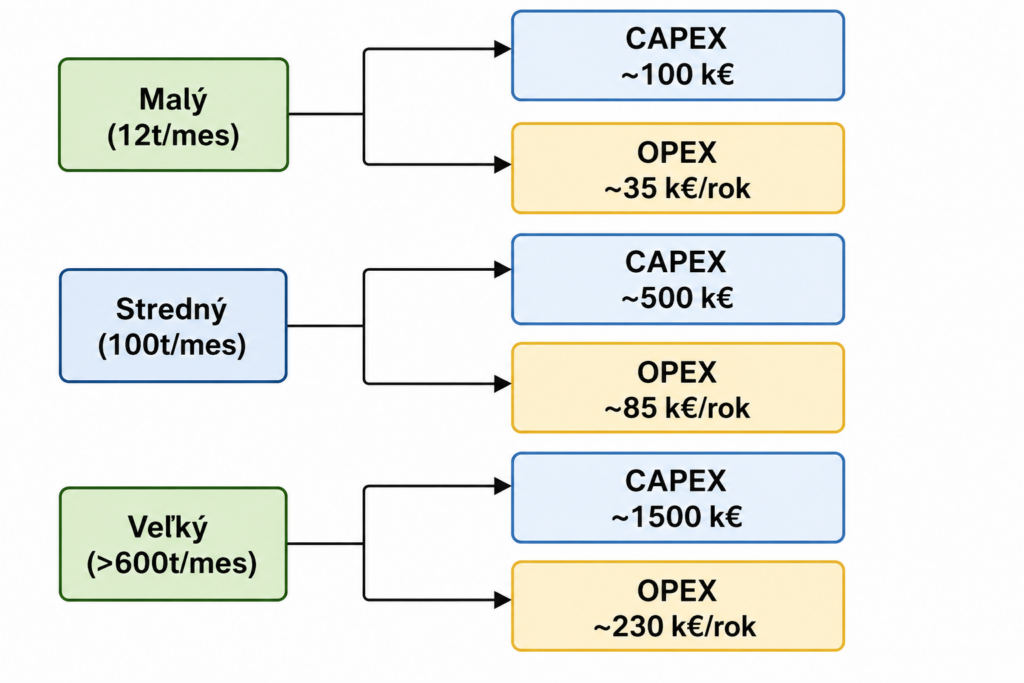
(Values are indicative; actual CAPEX/OPEX depends on technology. Data for small projects are extrapolated and may be higher in reality.)
4. Cashflow and return
Under these assumptions, the net cash flow of the projects would be negative in the long term, especially in the first years. If we calculate, for example, a 10-year horizon, the medium and small projects will not be able to collect the investment. The large project shows an approximately equilibrium flow (over 10 years), but the internal rate of return remains negative (unless subsidies are included). Realistic scenarios show that without financial support IRR is negative. With support (subsidies of 30-50 % CAPEX), IRR could approach zero or positive values (depending on the interest rate and financing period).
Cashflow example (large project):
- Year 0: capital investment –€1,500,000
- Years 1–10: income ~280,000 €/year (144k€ per char + 137k€ for credits) minus OPEX 230k€/year → annual net +50k€.
In 10 years, gross ~+500k€ (the inertia of the project then brings additional income).
(The measurement of financial indicators: IRR, NPV and payback period would be done in detail in an investment model with real rates and amortization. Rough indicative figures are used here.)
5. Integrated forest management
To achieve synergy, it is necessary to clearly set the rules for biomass harvesting:
- Removal rules: Only a portion of the total dead/excess biomass can be removed. We suggest leaving 50–70 % of coarse dead wood (CWD) and old trees that have high ecosystem value (habitat, gene pool), while removing 30–50 % of small dry branches, thinner branches and bushes that otherwise serve more as fuel. This corresponds to the compromise: minimize the fuel mass while not degrading biodiversity.
- Harvesting techniques: Low impact methods are preferred (hand thinning, mulching, open pyrolysis stove for small biomass). Large trees (biomass >0.4 m) and standing dead trunks would be left to fulfill their role.
- Fire protection belts: In threatened sites, key clearings should be reserved with vegetation removed for fire propagation; these strips are supplemented with heathlands and occasional controlled burning (where biodiversity allows). Maintenance of these clearings can provide feedstock for pyrolyzers (e.g. strips 10–20 m wide with renewal every 10 years).
- Integration with nature conservation: Protection zones (NP, PP, NATURA 2000) will assess collections in the local context so as not to violate legal obligations. For example, in Vlkovské lesy in the Slovak Republic, a part of dry biomass was allowed to be collected on small areas with the permission of the Forest Management Office at a lower risk and at the same time used for energy.
This regime will maximally support biodiversity (by leaving ~30–50 % of dead wood, we will maintain the viability of ~30 % species living in the forest), while at the same time significantly reducing the risk of large-scale fires (burning or export of dry matter as biofuel).
6. Draft MRV protocol for carbon credits (biochar CDR)
For compatibility with Puro/Verra/CRCF, the protocol would include:
- Inventory of inputs: Each batch of harvested biomass is recorded (weight, origin, type, moisture). It is mandatory to document that the biomass would otherwise be composted or burned.
- Yield and quality: Weight measurement and sampling of the produced biochar (C-org, H/C_org analyses, ascorbateable carbon, at least PAH analysis according to the EBC protocol). Part of the char is sent to accredited laboratories.
- Calculation of sequestered C: Based on the C_content of the biochar, we calculate the stored CO₂: (t biochar × C_% × 44/12) minus the pyrolysis impurity emissions. The carbon loss in the flue gas oxidation is attributed to the project (since the pyrolyzer will retain the main part of the carbon).
- MRV Accounting: An additional credit record (project number, tonnage, date) will be created for each biochar delivery. The validator will verify the aggregated balance of biomass vs. biochar vs. emissions. They will use common software under CRCF and connect to a centralized registry (as in CRCF).
- Ensuring Supplementation and Authenticity: Independent audits and confirmation that the project is „not BAU“ (investment additionality study) will be required. Guarantee of carbon sequestration for at least 100 years (insurance, national commitments, or confirmation of re-verification after a decade).
This MRV structure, based on a combination of Verra and Puro standards, ensures the integrity of the CDR market and prevents double carbon usage.
7. Institutional model and financing
For the sustainability of the project, it is necessary to clearly define ownership relationships and the flow of funds. We propose a model in which foresters/hikers a state (or NGO) they hold land/planting rights and share the proceeds, while pyrolysis operator procures technology and processes biomass. The scheme could look like this, for example:
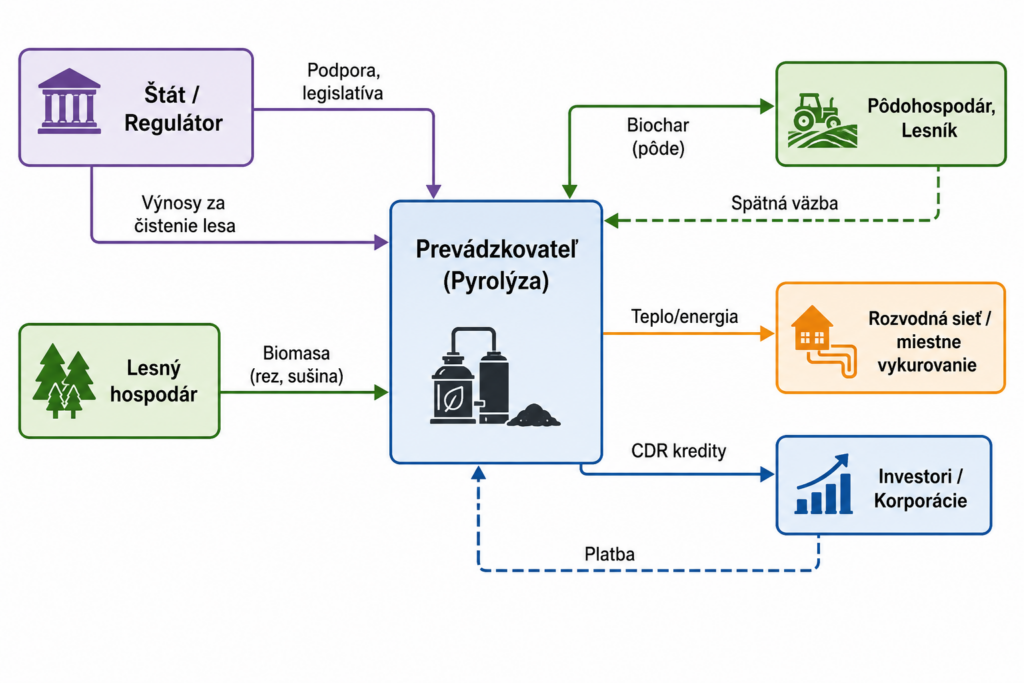
Legend: The forest manager provides forest waste; the state regulates and finances (subsidies, CDR guarantor); the operator produces biochar, which goes back to the soil (improves the soil for local farmers/foresters); the produced carbon credits are sold on the market to the investment sector. Revenues from the sale of credits (TRH) and biochar are shared between the investor and the municipal sector (e.g. 50% of the % profit goes to the forester/municipality as an incentive). The energy obtained from pyrolysis gases can cover operating costs (hot air heaters or cogeneration) and any surplus can be supplied to the local consumer.
Such a partnership enables: (i) sustainable investment – partly public funding (grants, ESG funds), (ii) fromdivision of a note – part of the revenues from carbon credits and biochar goes to forest owners (compensation for the use of biomass), (iii) cycle repetition – inputs (biomass from the forest) are recycled back into the soil, keeping the entire model circular.
8. Estimation of environmental benefits
-
Stored carbon (negative emissions): With the stock appreciation variety, ~0.7 tCO₂ from each ton of biochar produced.
- Small project: 15 t biochar/year → ~10 tC (36 tCO₂) per year.
- Medium: 90 t char → ~63 tC (231 tCO₂) per year.
- Large: 360 t char → ~252 tC (924 tCO₂) per year.
These numbers correspond to calculations in Verra/Puro (C-body in char) and LCA studies. With long-term stability (biochar lasts hundreds of years in soil), each project corresponds to thousands of tons of CO₂ stored over the life of the line.
-
Hydrological effects: Several studies have shown that the application of biochar improves the water capacity of soils. For example, experts point out that soil with biochar acts as if it had a „microsponge“ that retains more water. Some practical measurements have shown a reduction in irrigation consumption by 30–50 % on some crops. In forests, this means healthier trees in dry periods and lower risk of extreme stress. A cautious estimate of +10–20 % increase in water retention (depending on soil characteristics) in areas with biochar application can be used. This increases the forest's resistance to prolonged droughts.
-
Fire risk: By removing 30–50 % of combustible biomass, the probability of fire spread can be dramatically reduced. Prevention by harvesting „fuel“ (bottom layer biomass) is key: the literature describes that controlled fuel reduction leads to lower fire intensity and speed. Let us state qualitatively: according to foresters’ estimates, harvesting ~50 % of thin fuel (grasses, shrubs, small branches) can reduce the daily probability of a large fire by tens of percent in risk regions (CE Scandinavia, Mediterranean). In addition, biochar in the soil helps to retain moisture during dry spells, thereby indirectly reduces the occurrence of new fires.
-
Biodiversity: Leftover dead wood supports saproxylic species (insects, fungi, plants). Estimates show that up to 30 % to 50 % from forest biodiversity is associated with dead wood. Our management, which leaves thick trunks and old trees while harvesting dry branches, maintains most of the habitats for these species. The biochar itself also subsequently enriches the soil microworld – increasing microbial activity and economic fertility of the soil. The impact on biodiversity is therefore predominantly positive: pollution reduction (no open burning) and carbon recycling help to sustainably protect forest ecosystems, if the critical elements of the forest are properly maintained.
Numerical estimate of benefits: one large project (1200 t biom/year) can capture ~900 tCO₂ annually. Applying biochar to 10 ha of land could improve water retention capacity by ~20 % and reduce the cropping risk of fire on that area. At the same time, hundreds of cubic meters of dead wood would be preserved as habitat. These results are in line with international studies confirming the climate and ecological effectiveness of the biochar cycle model.
An integrated strategy that combines fire prevention collection, maintaining biodiversity a biochar production, creates a positive feedback loop: it protects the forest from catastrophic burning, supports natural ecosystems and commercializes carbon at the same time. The outputs are set to meet EU standards (EBC, CRCF) and national laws. The key is the right political support (subsidies, green finance) so that the economics of the projects match the environmental benefits. With adequate incentives, this model can make fire prevention more effective, increase the adaptation of forests to climate change and bring new sources of income for forest communities. JRi&CO2AI
Literature: CRCF (2024), VM0044 Verra (2023), EBC/IBI (2024), Puro.earth report (2025), EU Forest Strategy (2023), Nature Restoration Law (2024), EEA and SCIENCE articles, Slovak standards and laws on forests and nature conservation.

