 EN
 SK


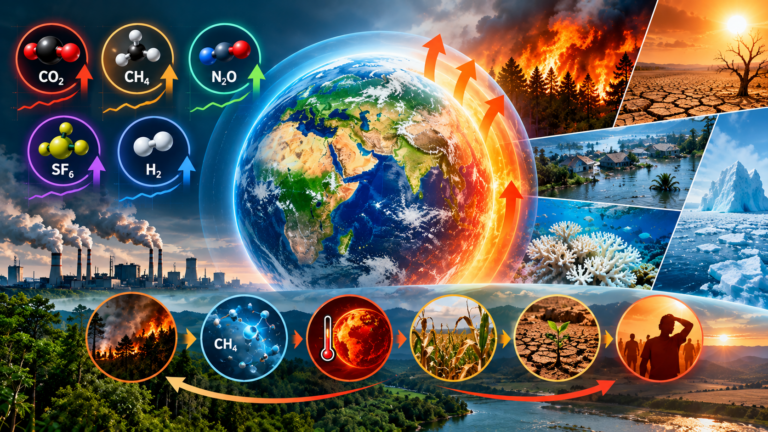
The global atmosphere is facing cumulative pressure unprecedented in recorded human history. According to findings The World Meteorological Organization (WMO) and its Global Atmosphere Watch program have reached the main greenhouse gases new, record highs. The last 11 years have been declared the warmest period in recorded history, with the main driving force of these changes remaining the uncontrolled increase in gas concentrations from human activity.
Record highs for major greenhouse gases
Carbon dioxide (CO2) concentrations reached 426.8 ppm, an increase of 53 ppm over pre-industrial levels. Although the annual increase of 2.8 ppm was slightly lower than the extreme jump of the previous year, it still exceeds the average annual growth rate over the past decade (2.63 ppm per year). CO2 remains the dominant factor in the climate crisis – accounting for about 66 % of the total radiative forcing of long-lived greenhouse gases and up to 83 % of its increase over the past decade.
Methane (CH4) in the atmosphere has reached a new historic high of 1,948 ppb, up 267 ppb from pre-industrial levels. Methane contributes approximately 16 % to the total radiative forcing. Although the annual increase of 6 ppb has slowed compared to the 10-year average (10.2 ppb per year), its long-term continuous increase since 2007 signals serious changes in both global biogenic and anthropogenic sources.
Nitrous oxide (N2O) rose to 339.1 ppb, 126 times the pre-industrial level. This gas is responsible for 6 % of radiative forcing. Global human-caused N2O emissions – mainly from the massive use of nitrogen fertilizers in agriculture – have increased by 30 % over the past four decades to 7.3 teragrams of nitrogen per year.
The NOAA AGGI (Annual Greenhouse Gas Index) shows that the total radiative forcing of long-lived greenhouse gases has increased by an alarming 56 % since 1990. Carbon dioxide alone contributed up to 81% of this total increase.
Hidden risks of energy transformation: SF6 and hydrogen
In the transition to renewables and electrification, attention will be focused primarily on reducing CO2. However, analyses warn of two less conspicuous but extremely dangerous gases: sulfur hexafluoride (SF6) and molecular hydrogen (H2).
Sulfur hexafluoride (SF6) is the most potent greenhouse gas known. Its 100-year global warming potential (GWP) is approximately 24,300 times that of CO2 and it can persist in the atmosphere for up to 3,200 years. SF6 is used primarily as an electrical insulator in high-voltage switchgear. With the development of global electrification, SF6 concentrations have increased from 3.5 ppt in 1995 to 12.24 ppt, a massive increase of 249 % in three decades. In addition, a record annual increase of 0.48 ppt has been recorded. Given that the only significant pathway for its degradation is photochemical decay in the mesosphere, today's SF6 emissions represent an irreversible climate commitment for thousands of years to come.
Although hydrogen (H2) is not a direct greenhouse gas, it has a strong indirect warming effect when released. Over a 20-year time horizon, it has an indirect GWP of 37±18 compared to CO2. Hydrogen in the atmosphere reacts with the hydroxyl radical (OH) – the main natural „cleaner“ of the atmosphere. This reduces the atmosphere’s ability to degrade methane and prolongs its lifetime. The concentration of H2 in the atmosphere has increased from 532 ppb in 2010 to 560 ppb (+5.3 %). Model studies suggest that uncontrolled releases of hydrogen during its massive use as an energy carrier could cause an additional warming of 0.05 to 0.1 °C by 2100.
Methane Isotope Anomaly: Warning of Climate Feedback
One of the most disturbing findings of the research is the behavior of stable carbon isotopes in methane (δ13C-CH4). Measurements from a global network of stations revealed a significant, previously unobserved isotopic anomaly from mid-2023 to late 2024.
While the total concentration of methane in the atmosphere continued to increase, the isotopic composition temporarily deviated from the long-term trend. Detailed analysis showed that the main cause of this anomaly was catastrophic forest fires in North America and the Amazon. Extreme heat and drought caused by climate change and the El Niño phenomenon have triggered record-breaking fires that have released huge amounts of methane, while microbial methane production in swamps has been temporarily suppressed by the drought.
This phenomenon is direct evidence of dangerous feedback: Climate warming disrupts terrestrial carbon sinks and triggers widespread fires, which in turn further accelerate the accumulation of greenhouse gases in the atmosphere.
Pressurized absorbers and massive underestimation of emissions
The ability of natural ecosystems to absorb human emissions is reaching its limits. In the period 2015–2024, approximately 50 % of emissions accumulated in the atmosphere, 29 % were absorbed by the oceans and 21 % by the terrestrial biosphere. If the absorption capacities of soils and forests deteriorate, the atmosphere will absorb an even larger share of emissions.
The situation is further distorted by the fact that officially reported emissions in many sectors are dramatically underestimated. Independent atmospheric measurements repeatedly reveal that real methane emissions from fossil fuels, waste management, and wastewater treatment plants significantly exceed the numbers in national reports.
Time to reverse the trend is running out
WMO data shows a clear and relentless picture: Earth's atmosphere is changing at a faster rate than nature can compensate. Rising levels of long-lived gases such as CO2, N2O and SF6, combined with new risks of hydrogen leaks and failing carbon sinks, are creating a storage trap. Without immediate and verifiable emission reductions across all sectors, the world risks crossing critical thresholds in the climate system with irreversible consequences for the entire planet. JRi&CO2AI

