 EN
EN  SK
SK 

This report elaborates an integrated model that combines forest and landscape fire prevention, biodiversity protection, processing of residual biomass and disaster wood into biochar, soil restoration, water retention, climate change adaptation measures and multi-source financing through public budgets, ecosystem payments and carbon markets. In the European context, this is an extremely powerful model because it simultaneously addresses three politically and market-driven problems: increasing damage from extreme fires, ecosystem degradation and the demand for high-integrity removals. The CRCF has already created the first pan-European voluntary certification framework for permanent removals, carbon farming and carbon storage in products, with mandatory third-party verification and a planned EU registry; at the same time, the Nature Restoration Regulation introduces binding restoration targets and directly links ecosystem restoration to adaptation, mitigation and disaster risk reduction.
The economic power of the model lies not in a single product, but in the „stacking“ of revenues: fees or contracts for fuel management and fire risk reduction, sales of biochar or biochar blends, carbon removal credits, payments for water and soil benefits, potential biodiversity/nature credits, and public grants or blended finance. It is this diversification that reduces the risk of dependence on a single market. Data from the US Forest Service shows that producing biochar from forest residues directly at the source can have significantly lower climate impacts than transporting biomass to distant locations or slash-pile burning; at the same time, the literature shows that the economics of the project are strongly influenced by logistics, equipment utilization, and grants.
From an implementation perspective, it is most important that the project is not understood as „biochar production“, but as landscape resilience infrastructure: a targeted intervention in the landscape, where pyrolysis is the end link of biomass management, not its goal. A high-integrity project must start with mapping fire risk, ecological limits and biodiversity priorities; continue through rules for biomass harvesting, including disaster wood; then through pyrolysis, LCA/MRV, accounting permanence and controlled use of biochar in soil, composts, reclamation or materials. The most advanced biochar methodological frameworks today are Puro.earth, Verra VM0044 and Isometric; Gold Standard is building a biochar methodology and ACR remains important mainly as a rigorous registry and market infrastructure, but does not yet list an explicit approved biochar methodology in the list of currently approved methodologies on its website.
The practical conclusion is that this model is already present in the world, but mostly in parts: in southern Europe and FIRE-RES in the form of living labs for fire-resistant landscapes and economic incentives; in northern Europe as a combination of biochar certification, pyrolysis and MRV; in the US as the economics of portable systems for forest residues; and in the UK mainly as a protocol and certification infrastructure through Isometric and research background around biochar permanence. However, there is no single universal label or dominant global design yet. The most appropriate term for the EU would therefore be integrated model of fire resistance and biochar carbon removal of landscapes. This analysis develops the initial concept from the working text in this chat.
Why is this model strategic?
The European political and climate context makes this model an unusually strong candidate for the „business model of the decade“. EFFIS reports that in 2024 the area burned in the EU reached 419,298 ha, of which around 147,017 ha were in Natura 2000 areas; Portugal alone experienced a series of fires in September that burned over 100,000 ha in a single week. This means that fire prevention is no longer just an environmental agenda, but an agenda of civil protection, agricultural stability, insurance and financial risk.
At the same time, Europe's nature is in poor condition. The Nature Restoration Regulation states that more than 80 % habitats are in poor condition, with the aim of measures covering at least 20 % of EU land and sea by 2030 and all ecosystems in need of restoration by 2050. The same regulation explicitly links ecosystem restoration to mitigation, adaptation and prevention of natural disasters and also states a high socio-economic multiplier, with 1 euro invested in nature restoration bringing between 4 and 38 euros in benefits. This is exactly the space where the integrated model of biochar, water, soil and fire resilience fits in.
The CRCF adds a market bridge. The European Commission describes the CRCF as the first EU-wide voluntary certification framework for permanent removals, carbon farming and carbon storage in products, with defined quality criteria, monitoring, reporting, verification and an obligation to publish certification information in an EU register. The implementing rules from 2025 are intended to make certification robust, but also cheaper and more administratively accessible, including group certification for smaller farmers and forest owners. This is critically important for a project that will aggregate more owners and more fire-prone sites.
From a market perspective, biochar is one of the most practical removal pathways today, as it is not solely reliant on the final credit buyer. Puro.earth describes it as the leading durable CDR technology in both delivery and market liquidity; its biochar methodology is approved and relies on a supply-chain approach from biomass sourcing through production to final use, with LCA, additionality, leakage and monitoring requirements. Isometric, on the other hand, offers monthly issuance and an optional durability of 200 or 1000 years, which is attractive to buyers looking for higher permanence and faster cashflow.
Definitions and architecture of the integrated model
Under fire prevention In this report, I mean the planned reduction of fuel loads and the spatial arrangement of the landscape in such a way as to reduce the likelihood of extreme fire behaviour. In FIRE-RES, this appears as „fire-resilient landscape design“, strategic networks of managed areas, innovations in economic drivers, insurance products and fire-wise planning. In Portugal, the living lab connects collaborative forest planning, the assessment of the impact of management options on landscape resilience and the design of a landscape mosaic more resistant to fires. In Catalonia, there is also open talk about the need to make preventive forestry interventions economically feasible and the creation of new insurance products.
Biodiversity protection here does not just mean „not damaging the protected area“. It means actively designing interventions to improve habitat heterogeneity, connectivity, regeneration after disturbances, water regime and ecosystem functions. The Nature Restoration Regulation explicitly includes forest indicators such as the steady increase in deadwood, forest connectivity, abundance of common forest birds and organic carbon stocks; therefore, the project cannot be based on „forest clearing“, but on selective management that respects the need to leave some of the biomass in the space and transform some of it into a valuable and long-term carbon store.
Biochar carbon removal is the removal of CO₂ from the atmosphere through the growth of biomass and its subsequent thermochemical stabilization into a carbon-rich form. Puro.earth defines biochar as a product of biomass pyrolysis that can store CO₂ for at least 200 years; its methodology works with robust calculations of net removals, leakage and LCA. EBC defines biochar as a porous carbonaceous material from biomass pyrolysis, applied so that the carbon remains stored as a long-term sink or replaces fossil carbon in industry; at the same time, it emphasizes that biochar is not intended for combustion for energy.
Calamitous wood and other residual biomass are important in this model because they are raw materials with low to negative local value, but high landscape-climatic relevance. The Puro methodology explicitly takes into account forestry by-products including sawdust, bark and forest thinning; American LCA/TEA studies show that forest residues left in place increase the risk of fires and that their conversion into biochar can be environmentally better than traditional pile burning or natural decomposition. An important condition, however, is that biomass collection is not guided by the logic of tonnage maximization, but by the ecological limits of the site and restoration priorities.
Ecosystem finance in this context, it means that the project monetizes more than carbon: reduced fire risk, improved water regime, higher infiltration and retention, restoration of soil structure, support for adaptation of communities and infrastructure, better conditions for biodiversity and potentially insurance and financial benefits. FIRE-RES directly works with economic drivers, insurance solutions, risk communication and funding mechanisms for post-fire restoration. In the EU, this is followed by the Nature Restoration Regulation and gradually the discussion on nature credits.
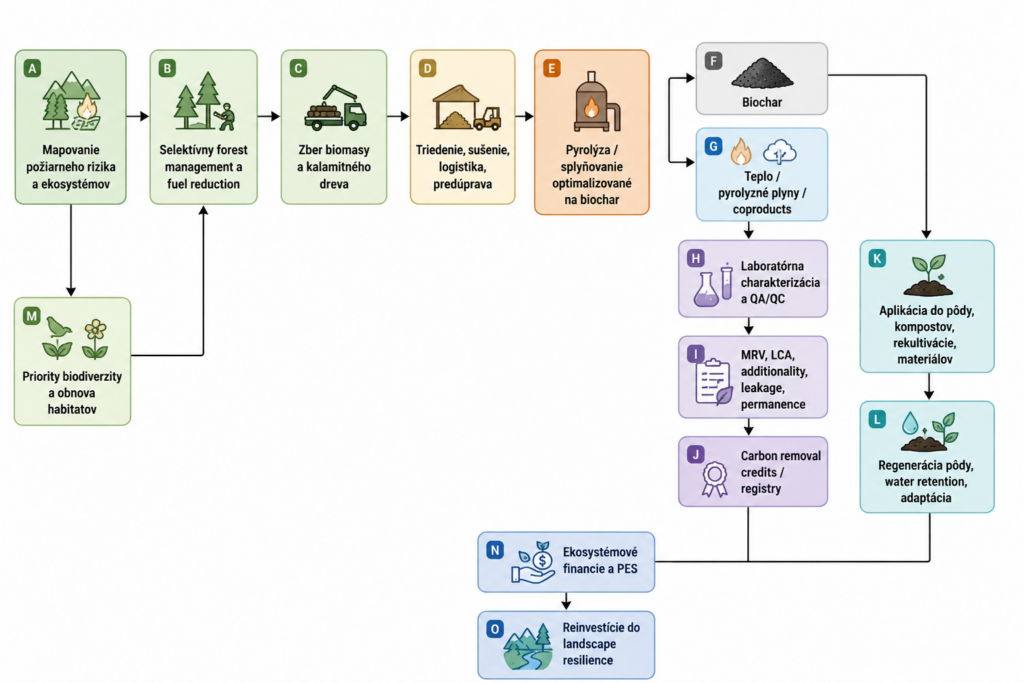
The following diagram shows the logic of the model as a single integrated system, rather than a series of separate projects. It is an analytical synthesis of regulations, methodologies and practical pilot designs.
Technical workflow, MRV and accounting permanence
The technical workflow should start at zoning of the land. It is necessary to separate areas where the priority is the protection of old growth and habitats, areas where selective intervention is needed due to extreme fuel load, and areas where disaster biomass is suitable for removal without ecologically unreasonable nutrient depletion or deadwood. The Portuguese FIRE-RES living lab shows that collaborative landscape planning and joint management of hundreds of owners is possible; the Catalan living lab shows the need to integrate land protection, WUI and the economic feasibility of prevention.
At biomass harvesting it is crucial to distinguish what is truly waste/residue and what is an ecologically valuable forest component. EBC uses a positive list of allowed biomasses and requires that the type of biomass within a batch does not change outside defined boundaries; Puro.earth requires transparent biomass sourcing, additionality, baseline and leakage control including feedstock diversion. This is exactly where disaster wood needs to be factored into the project rules: not every fallen or dead wood should automatically become feedstock, but a defined and documented portion of biomass can be removed as part of resilient management.
At pyrolysis it is more than just the facility itself. The EBC requires the use of excess heat or liquid and gaseous pyrolysis products and prohibits the discharge of pyrolysis gases without passing through a dedicated combustion chamber. This means that an environmentally sound biochar project must be designed as a more energy-closed and emission-controlled system, not a simple „charcoal plant“. Modularity is advantageous for the fire-ecological model: smaller or mobile facilities can reduce inbound logistics and the risk of transporting unnecessary amounts of wet biomass over long distances. USFS LCA/TEA studies show that near-forest/off-grid operations can have a better environmental balance than operations in urban locations precisely because of lower emissions from transportation.
At MRV three layers need to be distinguished: biochar quality, net removals and reversal risk. EBC is primarily a quality and product standard: it requires analyses, limits for heavy metals and for many classes it specifies H/Corg criteria, with H/Corg being a proxy for stability and degree of carbonation. Puro.earth goes further: the 2025 V2 methodology includes chapters on baseline, additionality, reversal risks, leakage, LCA, monitoring plan, sampling procedures, quality control and measurement uncertainty. Puro also requires that net removals are calculated via an LCA model in accordance with the principles of ISO 14040/44 and ISO 14064, with the rules of the methodology taking precedence.
At permanence accounting the market is starting to differentiate. Puro works with CORC 200+ and its methodology reflects new scientific knowledge about persistence. Isometric goes even further and allows for crediting for both 200-year and 1000-year durability; for 200 years it uses H/Corganic and projected decay curves, for 1000 years Random Reflectance (R₀). At the same time, Isometric publishes requirements for baseline, financial/common practice/environmental/regulatory additionality, leakage, dMRV, sampling plans, chain of custody and environmental/social safeguards. In terms of reversal risk, it is important that for many biochar projects the buffer may be low or zero, but the protocol still requires a reassessment of reversal risk and takes into account factors such as fires, oxidation, human intervention or change of management.
Final biochar application must pursue two goals: maximize ecological co-benefits and minimize reversal risk. Puro explicitly states that biochar can improve water and nutrient retention in soils, support productivity, water purification, site remediation and generate broader environmental and social benefits. EBC, in turn, distinguishes between applications to soil, feed, urban and materials. In practice, this means that an integrated model should use multiple sinks/end-uses: part of the biochar to soils and composts in degraded sites, part to reclamation, retention/filtration systems and, depending on the quality, also to material applications. This reduces market risk and at the same time increases the adaptability of the benefit portfolio.
Regulatory and market frameworks in the EU and comparison of standards
In the EU, the integrated model will have two distinct but interconnected „tracks“. The first is public law and political career: CRCF, Nature Restoration Regulation, wider LULUCF framework and bioeconomy policy. She is the second market track: voluntary registries, product and process standards, verification rules and corporate procurement. From a deployment perspective, this means that a project can have a public mandate and grant co-financing through landscape restoration, but at the same time generate private revenues through removals and products. The CRCF and the Nature Restoration Law thus create a legitimating and regulatory framework, while Puro, Verra, Isometric, Gold Standard and EBC provide certification and market entry mechanisms that can already be used today.
The following table compares the main relevant frameworks for biochar and the integrated landscape model.
| Framework | Frame type | Relevance for this model | Key strength | Current biochar status |
|---|---|---|---|---|
| CRCF | EU certification framework | Future European „public“ legitimacy for permanent removals, carbon farming and storage in products | EU rules, third party, EU register, group certification | Biochar is particularly relevant as a permanent removal / storage-in-products pathway in the methodological development of CRCF. |
| Puro.earth | Registries + methodologies for durable CDR | Today one of the strongest practical channels for biochar removals in Europe | Approved biochar methodology 2025 V2, CORC, LCA, leakage, monitoring, 200+ years | Approved and benchmarked solution. |
| Verra VM0044 | VCS methodology | Strong path for global projects including non-soil uses | Waste biomass to biochar, soil and non-soil applications, investment analysis, CCP eligibility | Active v1.2 from 27. 6. 2025. |
| Isometric | Certifier/registries/protocols | Strong for high-rigor buyer-side procurement and rapid issuance | Monthly issuance, 200/1000 years, dMRV, chain of custody, buffer logic | Active biochar pathway and detailed project requirements. |
| Gold Standard | Standard + registers | Strong for projects with a development and SDG profile | Engineered removals requirements, emphasis on SDGs and safeguards | The PARC biochar methodology is under development and methodological revision. |
| ACR | Registers/standard | Particularly relevant as a rigorous registry and compliance-adjacent platform | Science-based MRV, strong position in both regulated and voluntary markets | The approved biochar methodology is not yet explicitly listed on the approved methodologies page. |
| EBC | Product and process standard | Key to biochar quality, feedstock, emissions and end-use classes | Positive list of biomass, QA/QC, limits, pyrolysis technology rules | Voluntary European industry standard, widely used in practice. |
Verra VM0044 is important for this model mainly because it explicitly covers soil and non-soil applications, including biochar-amended concrete and building materials, and since version 1.2 requires an investment analysis to demonstrate additionality. This is very relevant for projects that will have mixed revenue streams from both products and credits.
EBC remains an essential „bottom layer“ of integrity in the EU, even if it is not a carbon registry. Its importance lies in the control of feedstock, process and product quality. In an integrated project, EBC or equivalent product quality should be considered as the default, even if the removals themselves will go through Puro, Verra or Isometric.
Financing, business model and risks
The most resilient business model is the one that combines public resilience finance + private carbon offtake + product sales + local ecosystem contracts. In practice, this means four cash layers: seed capital from grants/blended finance or green bonds; operating revenues from biomass collection and processing or fuel reduction contracts; ongoing sales from biochar and coproducts; and additional revenues from carbon credits, or possibly from biodiversity/PES layers. FIRE-RES shows that economic incentives, insurance solutions, and funding mechanisms for post-fire restoration are becoming an explicit part of wildfire governance. CRCF and Nature Restoration Law create demand for publicly legitimized interventions in the landscape; Puro, Verra, and Isometric create private-market cashflows.
| Income stream | How value is created | When does it enter? | Main risk | Graduation |
|---|---|---|---|---|
| Fuel reduction and fire resilience contracts | Public procurement, land administration, utilities, municipalities, protected areas | Almost | Budgetary and political volatility | High in fire-prone regions |
| Sales of biochar / biochar mixtures | Soil, compost, reclamation, filtration, materials | Early to medium early | Local demand, product quality | Medium |
| Carbon removal credits | Net removals after MRV and verification | Medium early | MRV difficulty, price volatility, buyer diligence | High and growing |
| Payments for ecosystem services | Water, erosion, retention functions, municipal adaptation | Medium early | Poor standardization of contracts | Rather early |
| Biodiversity / nature credits | Habitat improvement, connectivity, species outcomes | Later | The market is still embryonic | Early |
| Green bonds / PPP / blended finance | Infrastructure and rollout financing | At the beginning | Investment credibility and bankability | High if there is an anchor buyer and a public partner |
The synthesis of the table is based on EU regulatory frameworks, FIRE-RES living labs and the requirements of the main registries/methodologies.
On the cost side, the biggest mistake is to underestimate logistics, biomass moisture, laboratory regime and MRV transaction costs. USFS studies show that the MSP of biochar from portable systems can vary very widely; one study reports an MSP of approximately 580 to 5000 USD/t depending on the system and operating conditions, another for biochar pellets from forest residues reports approximately 528 to 1909 USD/t of applied biochar for different technologies, while environmental performance and economics are strongly sensitive to logistics and equipment utilization. As an analytical estimate for a European pilot, it is therefore reasonable to count on preparation and permitting in the hundreds of thousands of euros, infrastructure and pyrolysis line rather in the millions of euros and an annual MRV/QA/lab/verification budget in the tens to hundreds of thousands of euros at least. This estimate is inference, not a supplier offer.
Risks should be divided into four groups. Environmental risks: overly aggressive biomass harvesting, habitat degradation, nutrient export, inappropriate biochar applications to unsuitable soils. Supply chain risks: moisture, contamination, feedstock inconsistency, poor equipment utilization. Permanence and MRV risks: overvalued removals, weak chain of custody, feedstock diversion, reversal through oxidative use. Reputational risks: greenwashing, conflict with nature conservation, export of profits outside the region. Puro explicitly categorizes leakage including ecological leakage and market/activity shifting leakage; Isometric requires leakage assessment, environmental impact assessment, FPIC and monitoring chain of custody; Nature Restoration Law sets the political bar that a project must contribute to nature's resilience, not circumvent it.
Pilot rollout, KPIs and recommended implementation
The recommended pilot should be territorial, not technological. The ideal scope is one contiguous or functionally linked region with high fire risk, with a combination of forest and agricultural areas, with real availability of disaster wood and with at least one „anchor buyer“ for removals or products. A suitable stakeholder architecture includes: forest and land owners, municipality/region, fire and civil protection departments, protected area or watershed manager, pyrolysis technology supplier, agronomists and hydrologists, laboratories, MRV partner, registry partner and at least one corporate offtaker.
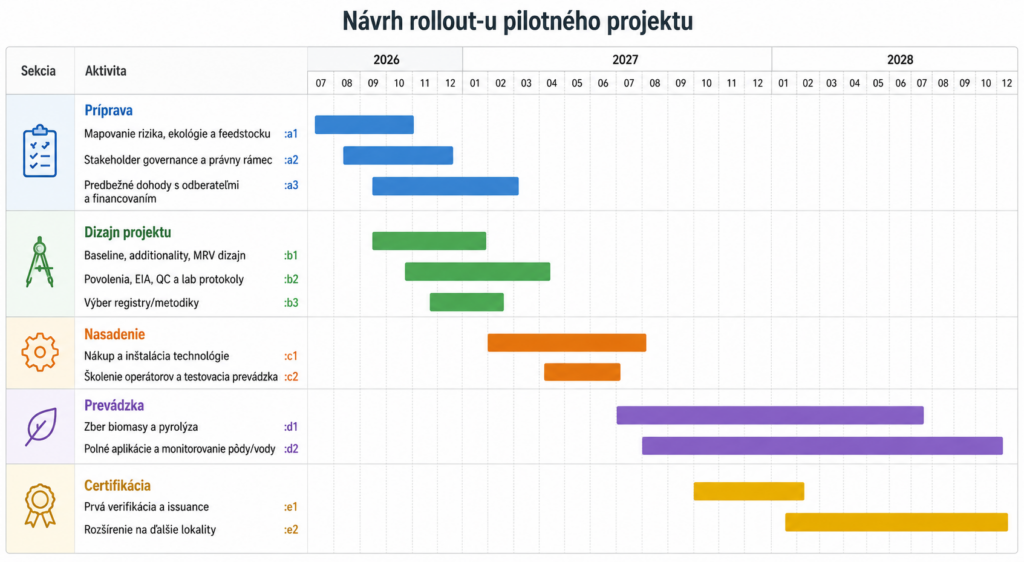
The following mermaid axis outlines a realistic pilot rollout. It is an implementation synthesis based on EU regulatory deadlines, monitoring plan requirements and a practical deployment sequence.
Recommended KPIs should be divided into landscape, carbon, soil-water, biodiversity, economy a governance layer.
| KPIs | Why is it important? | Measurement type |
|---|---|---|
| Ha of treated land and ha of reduced fuel load | Basic fire resistance | GIS + field ops |
| t of wet biomass and t of dry matter processed annually | Real supply base | Weighing + moisture accounting |
| t biochar and biochar yield | Technical process performance | Process data + lab |
| Net tCO₂e removed / year | Main removal output | LCA + MRV |
| Share of biomass from residual/calamitous flows | Feedstock integrity | Chain of custody |
| H/Corg, Corg, contaminants, ash | Proxy quality and stability | Laboratory tests |
| Change in infiltration capacity, WHC, bulk density, SOC | Soil and retention benefits | Soil monitoring |
| Erosion and runoff indicators | Adaptation and water retention | Hydrological monitoring |
| Habitat indicators, connectivity, deadwood governance, selected species | Biodiversity outcome | Ecological monitoring |
| €/ha resilience spending, €/tCO₂e, share of local remaining value | Economic efficiency | Financial reporting |
| Share of revenues returned to landowners/community | Social license and just transition | Governance KPIs |
| Number of incidents, non-conformities, audit findings | MRV integrity | QA/QC and verification |
The Puro methodology, Isometric requirements, EBC and Nature Restoration Law show that monitoring plans, sampling, QC, leakage and environmental-social safeguards must be designed from the beginning, not as an afterthought.
International examples, recommended terminology and policy actions
Best documented today partial archetypes This model is not in one country, but in a combination of multiple ecosystems. The Iberian example is strongest in terms of landscape governance: the Portuguese FIRE-RES living lab works with Natura 2000, strategic landscape management and joint planning with a number of owners; to this is added the factual urgency of the Portuguese fires in EFFIS. Mediterranean example Catalonia is added, where the economic feasibility of preventive interventions and insurance solutions is openly addressed. Nordic example is different: the Norway-Sweden living lab shows that even boreal countries must adapt knowledge from southern Europe to new fire regimes; there is great scope for connection with biochar certification and material applications.
Western USA is today the strongest reference example from the point of view of the techno-economics of forest residue processing. USFS publications show that portable systems applicable to forest residue resulting from fuel treatments can be environmentally and economically meaningful, especially if they are operated close to the biomass source and if they rely on grants or other sources of revenue. For California, the open sources in this report are better verified earlier market and institutional proximity via ACR and California compliance-adjacent infrastructure rather than a comprehensive publicly described end-to-end fire-to-biochar pilot; this is important to say openly.
UK is stronger in the analyzed sources so far rather than methodological and market infrastructure than as the best documented landscape pilot. Isometric is a London-based certification platform with a detailed biochar pathway, 200/1000-year durability regimes, leakage assessment, environmental and social safeguards and explicit sampling/chain-of-custody requirements. This is of particular interest for EU countries and Central European pilots, especially if buyer-side demand is moving towards „high rigor removals“ with faster issuance.
Australia is relevant as a partial and historically important area of biochar commercialization and applied research, but in the open primary sources that I used in this report, I was not able to document a fully integrated model linking wildfire prevention, biodiversity, forest residues and carbon markets as well as in the USA or in FIRE-RES. Therefore, in this report I present it rather as partial benchmark, not as the main reference pilot.
For the EU, I recommend using terminology that is understandable to the regulator, investor and forest owner. Names that do not reduce the model to carbon only work best. Recommended terms are: integrated model of fire resistance and biochar carbon removal of landscapes, fire-resilient biochar landscape finance, possibly landscape resilience carbon removal model. Such a name better captures that the main value is not just removal credit, but a resilient landscape as a public good infrastructure.
The recommended policy steps for the EU and Member States are as follows. First, CRCF methodologies should allow for aggregated, territorial projects linking multiple owners, multiple locations and a combination of land and material end-uses. Second, public landscape restoration and civil protection programmes should recognise biochar-based utilisation of residual biomass as part of wildfire resilience, not as a purely industrial waste project. Third, Member States should develop rules that align biodiversity safeguards, deadwood retention and controlled biomass extraction to avoid forest „over-harvesting“. Fourth, blended-finance structures linking grant, offtake and resilience payment should be tested in pilot regions. Fifth, the EU should support interoperability between CRCF and existing high-integrity registries to avoid duplication of bureaucracy.
Open questions and limits
The biggest open question remains optimal limit of biomass extraction in individual ecosystem types. An integrated model may behave more aggressively economically than is ecologically appropriate; therefore, the project must have explicit ecological guardrails from the beginning. Another open question is how exactly the CRCF will be methodologically addressed for biochar in combined landscape projects and how it will align with existing voluntary methodologies.
The second limit is that international examples are today fragmented. We have very good living labs for fire-resilient landscapes, very good registries and methodologies for biochar removals, and relatively good techno-economic studies for forest residues; less common are publicly described projects in detail that would already connect all layers from fuel treatment to MRV to ecosystem finance in one open source. But that doesn't mean the model doesn't exist; it means that it is taking shape as a new class of projects right now. Author: JRi&CO2AI

